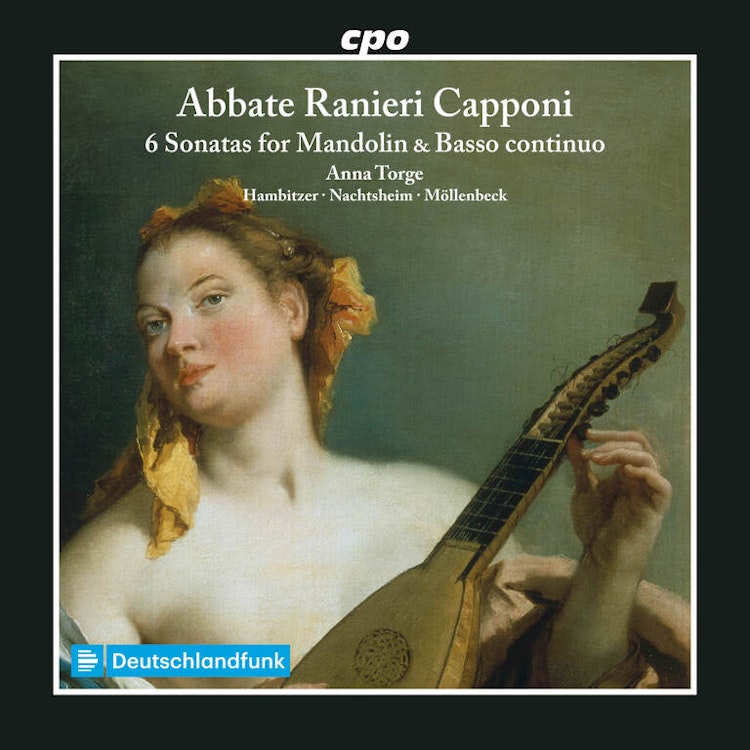
Abbate Ranieri Capponi: 6 Sonatas for Mandolin & Basso continuo
1/3/2025, 18 Tracks, 1:04:15
Featuring
Andreas Nachtsheim
Anna Torge
Gerald Hambitzer
Markus Möllenbeck
Ranieri Capponi
Did you know?
1/7
Instruments
The Baroque mandolin, the smallest member of the lute family, was a popular and respected instrument in 17th- and 18th-century Italy, with composers like Vivaldi and Scarlatti writing for it.
Historical Context
The dedication of these sonatas to Clement Augustus, Archbishop of Cologne and Elector of the Holy Roman Empire, reflects the high social standing of the Capponi family and their connections to the imperial family.
Performer Biography
Gerald Hambitzer, a sought-after harpsichordist, has contributed to over 50 CD recordings, many of which have won prestigious awards including the Grammy Award.
Composition History
These 12 sonatas by Ranieri Capponi were published posthumously in 1744 by his brother, Ruberto Capponi, in Florence.
Performer Biography
Anna Torge, a leading soloist on the mandolin, has performed with major orchestras and conductors worldwide and was selected for Yehudi Menuhin's 'Live Music Now' initiative.
Composer Biography
Abbate Ranieri Capponi, the composer of these sonatas, was a popular and influential composition teacher during his lifetime, though little else is known about him.
Instruments
The Baroque mandolin is particularly suited to render the polyphonic texture of Capponi's compositions due to its tuning in fourths and thirds.
You might also enjoy...
Mondonville: Les Sons Harmoniques, Op. 4
Jacquet De La Guerre: Sonates pour violon
Rebel: Violin Sonatas
Pietro & Prospero Castrucci: Sonatas for Violin and B.C.
Biber: Violin Sonatas
Biber: Violin Sonatas
Domenico Ferrari: 6 Violin Sonatas, Op. 3
Biber: Violin Sonatas (1681)
Agus: Sonate a violino solo e basso
Just Biber
Handel: Violin Sonata in D Major, HWV 371: I. Affetuoso