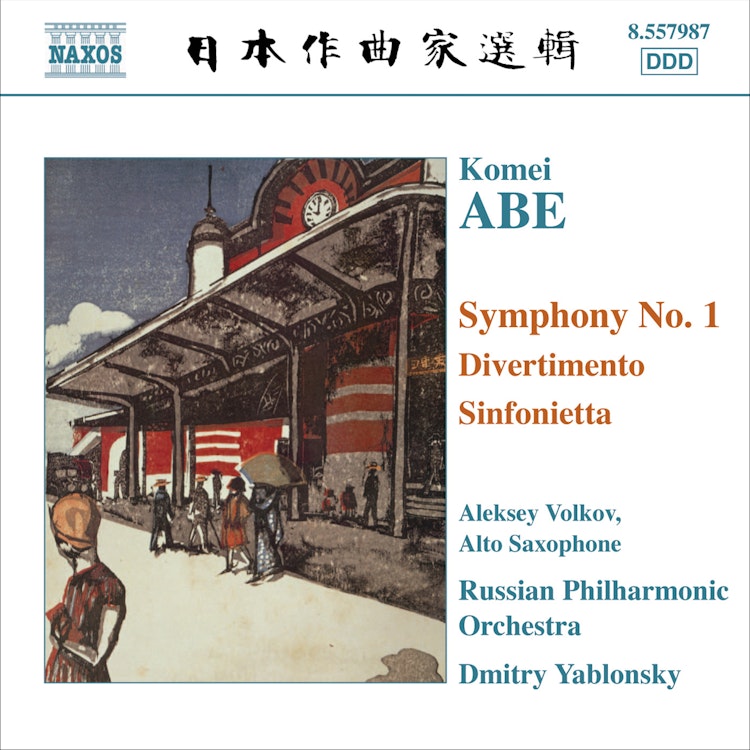
Komei Abe, the composer, was strongly influenced by his teacher Klaus Pringsheim's view of music, which spanned from late romanticism (Mahler, Richard Strauss) to neoclassicism (Hindemith, Kurt Weill).
Composer Biography
Komei Abe, the composer, worked at the Ernie Pyle Theatre in Tokyo during the American occupation after World War II, composing and arranging music for modern dancing, which deepened his interest in rhythmic music.
Performer Biography
Aleksey Volkov, the alto saxophonist, is an Honoured Artist of Russia, a leading teacher of the Russian school of saxophone, and a soloist with the Bolshoy Orchestra.
Compositional Technique
Komei Abe, the composer, was influenced by the 'enharmonium', an instrument invented by physicist Shohei Tanaka that could reproduce all tonalities in just intonation, leading him to prefer string instruments.
Composer Biography
Komei Abe, the composer, grew up moving from city to city with his father, an army officer, and was enchanted by the sound of violins in the streets of Tokyo.
Composer's Artistic Vision
Komei Abe, the composer, rejected the nationalism and primitivism embraced by some of his contemporaries, stating that modern Japanese people were international and could sympathize with composers like Wagner and Verdi.
Historical Context
Japan's national policy of Westernisation after a long period of isolationism led to Western music being adopted in the educational system, making it more familiar to urban children than traditional Japanese music.
You might also enjoy...
Hindemith Conducts Hindemith
The Chicago Symphony Orchestra Recordings
Anatol Vieru, Vol. 2
Skrowaczewski: A Centennial Tribute
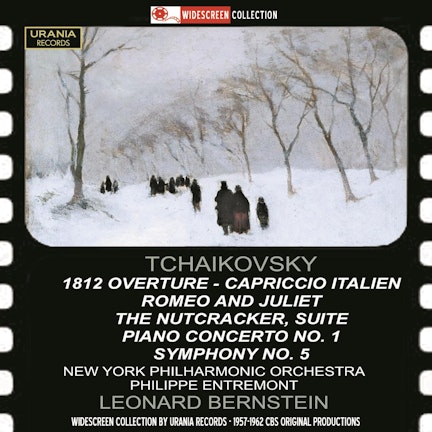
Tchaikovsky: 1812 Overture, Capriccio Italien, Romeo & Juliet, The Nutcracker Suite, Piano Concerto No. 1 & Symphony No. 5
Ansermet Encores
Leopold Stokowski: Great Recordings from the BBC Legends Archive, Vol. 2