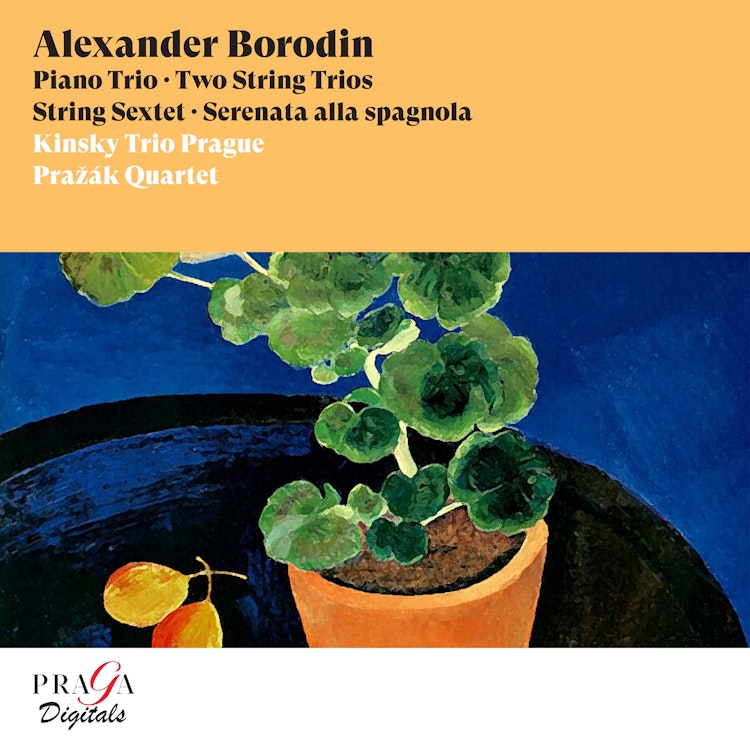
Alexander Borodin: Piano Trio, String Sextet, Two String Trios, Serenata alla spagnola
9/1/2011, 9 Tracks, 55:07
Featuring
Lucie Sedláková Hůlová
Martin Sedlák
Slávka Pěchočová
Pavel Hůla
Vlastimil Holek
Josef Klusoň
Jan Pěruška
Michal Kaňka
Kinsky Trio Prague
Pražák Quartet
Alexander Borodin
Did you know?
1/7
Composition History
The Piano Trio in D major, though unfinished, was first published in 1950, nearly a century after its composition in 1862.
Composition History
Borodin's Serenata alla spagnola is part of a collective work, with other movements contributed by Rimsky-Korsakov, Liadov, and Glazunov, as an homage to their patron and publisher Mitrofan Belayev.
Historical Context
While studying in Heidelberg (1859-60), Borodin met Dmitri Mendeleyev, the chemist known for his periodic classification table of chemical elements.
Compositional Technique
The central part of Borodin's Intermezzo in the Piano Trio features a four-part melody for strings alone, designed to evoke the sound of the gudok, an ancient Russian stringed instrument.
Compositional Technique
The common theme for the collective work including Borodin's Serenata alla spagnola is derived from the German notation of the name B-La-F (B flat-A-F), representing their patron Mitrofan Belayev.
Composer Biography
Alexander Borodin, a chemist by profession, referred to his early chamber works written between 1850 and 1860 as 'little sins of youth'.
Compositional Technique
Borodin's String Sextet in D minor includes pizzicati in its second movement that imitate the sound of balalaikas, a Russian folk instrument.
You might also enjoy...
Borodin: Chamber Music
Boccherini: 6 String Quartets, Op. 2
Schubert: The Piano Trios; Piano Quintet "The Trout"; String Quintet; Octet D 803; Arpeggione Sonata etc.