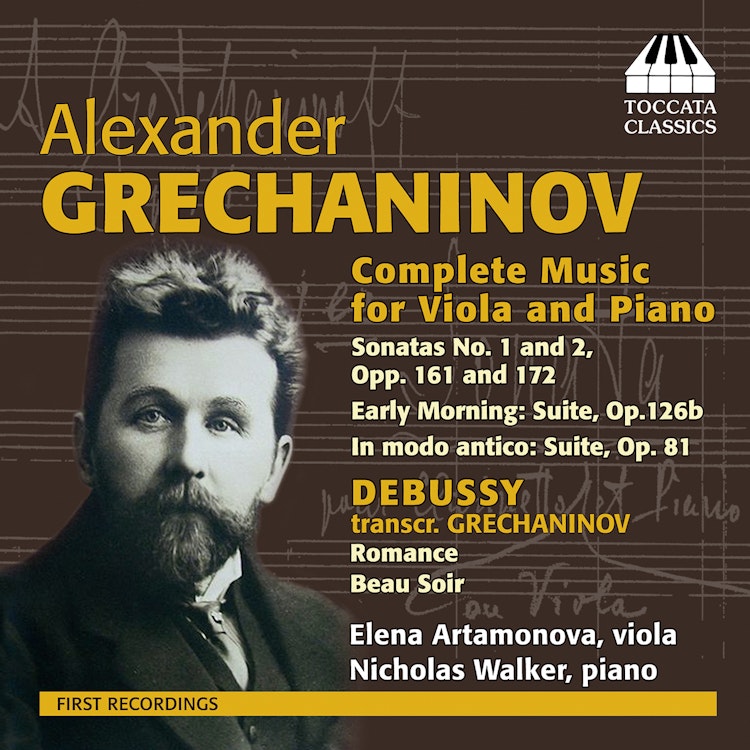
Alexander Grechaninov: Complete Music for Viola & Piano
4/1/2014, 29 Tracks, 1:06:43
Featuring
Elena Artamonova
Nicholas Walker
Alexander Gretchaninov
Claude Debussy
Did you know?
1/7
Composition History
Grechaninov's Sonata for Viola (or Clarinet) and Piano, Op. 161, was written between 1935-1940 when he was in his mid-seventies and was premiered only in 2013.
Composition History
Grechaninov composed the suite In modo antico, Op. 81, in 1918 during the Russian Civil War, possibly as an escape from the harsh realities of the post-revolutionary period.
Recording & Production
This album includes several first recordings, with the Sonata No. 1, Romance, and Beau Soir being first recordings, and Sonata No. 2, Early Morning, and In modo antico being first recordings in these versions.
Compositional Technique
The second movement of Grechaninov's Viola Sonata No. 2, Op. 172, features variations on a Slavic folksong theme with constant metric modulation between 7/8 and 3/4.
Composer Biography
Alexander Grechaninov's path to professional music was unusual; he was largely self-taught until age seventeen and faced opposition from his father, who wanted him to pursue a different career.
Composer Biography
Grechaninov studied piano with Nikolai Kashkin and Pyotr Tchaikovsky, and composition with Sergei Taneyev, but had a major conflict with another teacher, Anton Arensky.
Composer's Artistic Vision
Grechaninov, despite keeping abreast of modern innovations, created a unique style by adhering to national idioms, using Russian melody, and emphasizing the singing quality of each instrument.