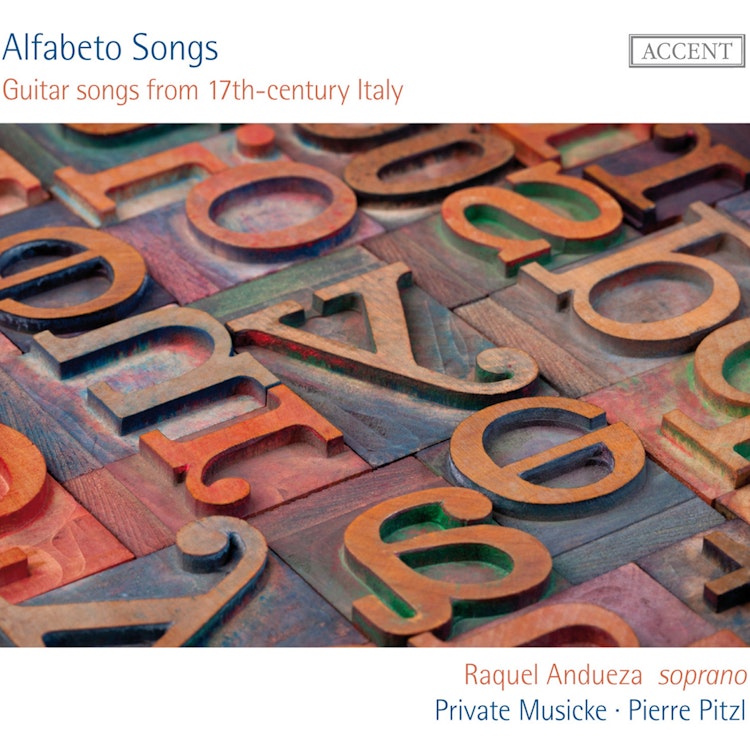
Alfabeto Songs: Guitar songs from 17th-century Italy
1/1/2013, 17 Tracks, 58:26
Featuring
Pierre Pitzl
Raquel Andueza
Theresa Dlouhy
Private Musicke
Giovanni Stefani
Giovanni Girolamo Kapsberger
Giovanni Paolo Foscarini
Marcantonio Aldigiatti de Cesena
Flamminio Corradi
Francesco Corbetta
Girolamo Montesardo
Tarquinio Merula
Bartolomeo Barbarino
Gaspar Sanz
Did you know?
1/6
Compositional Technique
Some composers, such as Foscarini, Calvi, and Sanz, used 'alfabeto falso' letters for dissonant chords, including four-three suspensions, seventh chords, and daring acciaccaturas.
Cultural Impact
The 'Alfabeto' system allowed amateur musicians who could not read music to quickly learn songs and dances, leading to hundreds of printed editions of guitar music using this notation in the 17th century.
Historical Context
The 'Alfabeto' notation system and the 5-string Chitarra espagnola, which emerged around 1580, played a role in the development of monody and the new harmonic chordal concept in early 17th-century music.
Composer's Artistic Vision
Girolamo Kapsberger, a lutenist and composer, published seven books of villanelles between 1610 and 1640, which were highly popular and composed by nearly all major Italian composers of the 16th and 17th centuries.
Compositional Technique
The 'Alfabeto' system, developed by Girolamo Montesardo in 1606, is a fingering notation system for guitar chords that assigns a single letter to each chord.
Composer Biography
Francesco Corbetta, born in 1615, was considered the outstanding guitarist of his time and was called 'El mejor de todos' (the best of all) by his Spanish colleague Gaspar Sanz.
You might also enjoy...
A piacere: Music for Viola da Gamba
Carnets de voyages
De Visée: La musique de la chambre du roy
La Hacha
Night Music
L'Univers de Marin Marais
O dulcis amor
Catharsis
Chamber Music (Renaissance) - Bassano, G. / Casa, G. Dalla / Fontana, G.B. / Bovicelli, G.B. / Rognoni, R. / Palestrina, G.P. Da (Le Concert Brise)