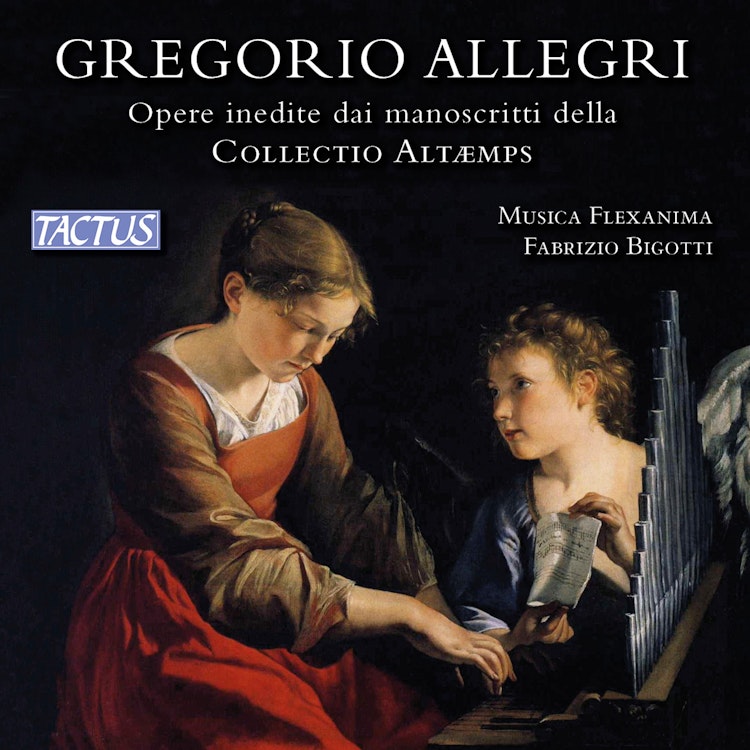
Allegri: Opere inedite dai manoscritti della Collectio Altaemps
6/2/2015, 18 Tracks, 1:14:15
Featuring
Fabrizio Bigotti
Simone Colavecchi
Simona Braida
Musica Flexanima Ensemble
Gregorio Allegri
Pierre Bonhomme
Giovanni Francesco Anerio
Did you know?
1/7
Composer's Artistic Vision
Gregorio Allegri's music balanced the traditional a cappella style with the emerging monody and new tonal demands of the 17th century, concluding the Renaissance contrapuntal era with new splendor.
Compositional Technique
Gregorio Allegri's hymn Salutis humanae sator creates a surprising modulation effect by concluding each strophe a semitone lower than the next.
Composition History
The pieces on this album come from the Altemps manuscripts, a collection of sacred music compiled by Giovanni Angelo Altemps, a Duke who established a private musical chapel in his Roman residence.
Composition History
The Altemps manuscripts, considered lost for many years, reappeared in 1992 and were donated to the Museo Nazionale Romano of Palazzo Altemps in 2000, where they are now housed.
Composer Biography
Gregorio Allegri, though famous for his Miserere, spent most of his career in Rome, serving in various musical capacities including as a singer in the Papal Chapel.
Historical Context
The Altemps manuscripts were so exclusive that they contained an excommunication order, penned on the manuscripts themselves, against anyone who illegitimately acquired even a single page.
Compositional Technique
The instrumental pieces from the Altemps collection feature unusual instruments for sacred music of the time, such as the spinet, theorbo, lute, and even trombone, showing influence from Venetian instrumental style.
You might also enjoy...
Fede e Amor
Lechner: Neue teutsche Lieder
El Misteri D'Elx/Ensemble Gilles Binchois/Vellard
Ghirlanda sacra
Selle, T.: Auferstehung Christi (Die) (Historia - Sacred Concertos and Motets for Easter)
Charles-Joseph Van Helmont: Leçons de ténèbres
Pollux Wind Quintet
Anatomías
Festa: Mottetti
Festa: Mottetti, Vols. 1 & 2
Stylems, Italian Music from the "Trecento"
Festa: Mottetti, Vol. 2
Speculum Amoris: Lyrique de l'amour médiéval, du mysticisme à l'érotisme