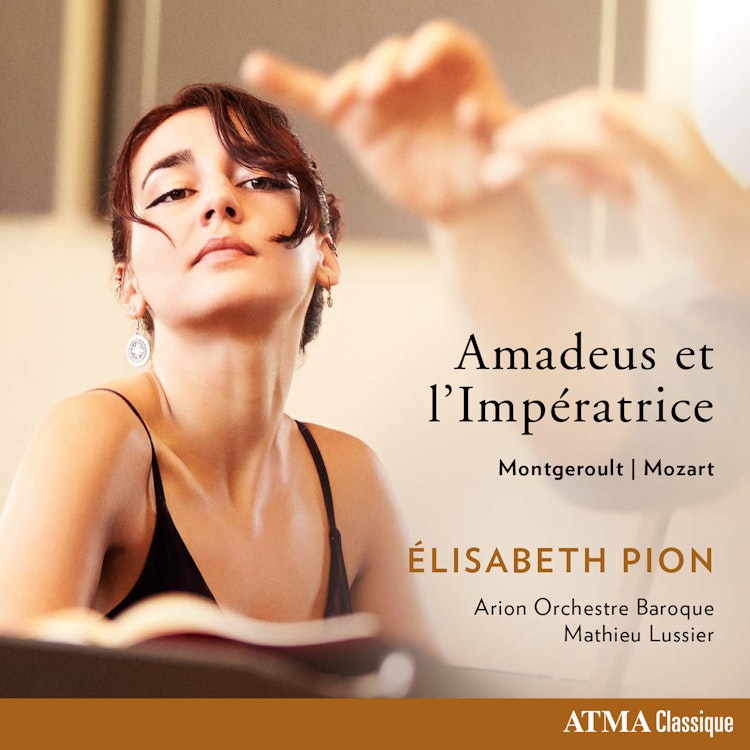
Hélène de Montgeroult, a child prodigy on piano, performed exclusively in salons due to her noble status, becoming a marquise in 1784.
Interpretation
Pianist Élisabeth Pion composed her own cadenzas for the two concertos on this album, as Mozart did not leave a written cadenza for his Concerto No. 24.
Composition History
Hélène de Montgeroult's first piano concerto was created by transcribing and recomposing two violin concertos by her friend Giambattista Viotti, a great violinist who founded the 19th-century school of violin playing.
Compositional Technique
Montgeroult's piano writing for her first concerto involved significant recomposition for both hands and considerable changes to the orchestration, especially in the first movement, to make the pianoforte and orchestra blend effectively.
Historical Context
During the French Revolution, Hélène de Montgeroult saved herself by brilliantly improvising variations on 'La Marseillaise' in front of the Committee of Public Safety in 1794.
Composer's Artistic Vision
Hélène de Montgeroult is considered a pioneer of the concert etude, a form later attributed to Chopin and Liszt, and her 700-page 'Cours complet pour l'Enseignement du Forté Piano' from 1812 is the most important method of the 19th century.
Compositional Technique
Montgeroult's Etude No. 19 in F Major is an homage to Bach's Prelude No. 1 in C Major but features harmonies Bach would not have imagined, while other etudes evoke Chopin and Schumann, who were born decades after her.
You might also enjoy...
The Berlin Years - Mozart, Beethoven, Dvořák, Bruckner, Wagner
Chopin's Pupils
Daniel Barenboim - A Portrait
Complete Concerto Recordings
D'Indy: Symphonie sur un Chant Montagnard Français, Op. 25 & Franck: Variations symphoniques & Mozart: Piano Concerto No.21