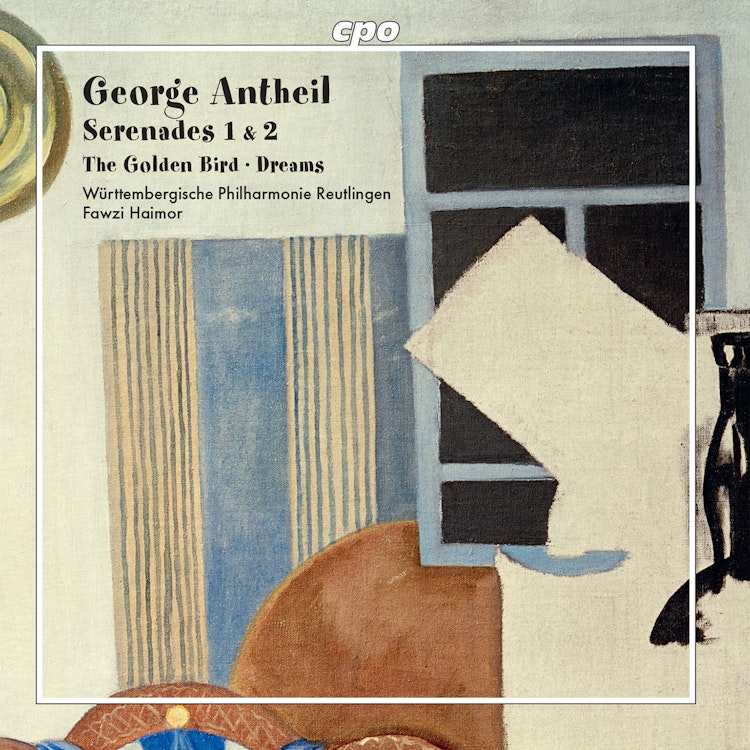
The American composer George Antheil made a scandalous impact in Paris in the early 20th century with a series of shockingly modern works. But his compositional career took a softer, more modest turn afterwards. This album from the Württembergische Philharmonie Reutlingen and Fawsi Haimor traces Antheil from the 1920s through to the late 1940s, featuring the early Golden Bird, his mid-period music for George Balanchine’s ballet Dreams, and two late Serenades.
Featuring
Fawzi Haimor
Württembergische Philharmonie Reutlingen
George Antheil
Did you know?
1/7
Composer Biography
George Antheil, born in Trenton, New Jersey, traveled to Europe in 1922 with significant musical talent, promising piano skills, and impressive compositional ambition.
Composition History
Antheil's early works, such as Sonata II "Street Sonata" and Sonata III's "Airplanes" finale, were later transformed into other compositions, including a piano concerto and his "Airplane Sonata."
Performer Biography
Fawzi Haimor studied violin at the Jacobs School of Music at Indiana University and also pursued conducting studies with David Effron and Arthur Fagen.
Composer Biography
Antheil's American teacher, Ernest Bloch, who taught talented students for free, returned most of his tuition fee, indicating Antheil's significant aptitude.
Composer Biography
George Antheil's early artistic decisions were influenced by the sensational career of Leo Ornstein, a Russian-American composer and pianist who gained fame for his "ultramodern" music.
Performer Biography
Fawzi Haimor, the conductor, was born in Chicago in 1983 and grew up in the Middle East and San Francisco.
Composer's Artistic Vision
Antheil's "The Golden Bird" was originally titled "Chinoiserie" with the subtitle "The Chinese Magician" before being renamed to allude to Constantin Brâncuși's famous sculpture "Oiseau d'or."
You might also enjoy...
String Orchestra Gems by Suk & Tchaikovsky
Walter Piston: Serenata for Orchestra - David Van Vactor: Fantasia, Chaconne and Allegro - Niels Viggo-Bentzon: Pezzi Sinfonici, Op. 109
Hans Huber Early Works for Orchestra (World premiere recording)
Louis Lane & The Cleveland Orchestra: The Latin America Album
Serenade Op. 75/ Romance Op. 42/ Suite after Russian Folk Songs Op. 796