The frottola, a simple, folk-like song with chordal harmonies, emerged around 1480 in Mantua as Italians developed their own musical style.
Album & Artwork
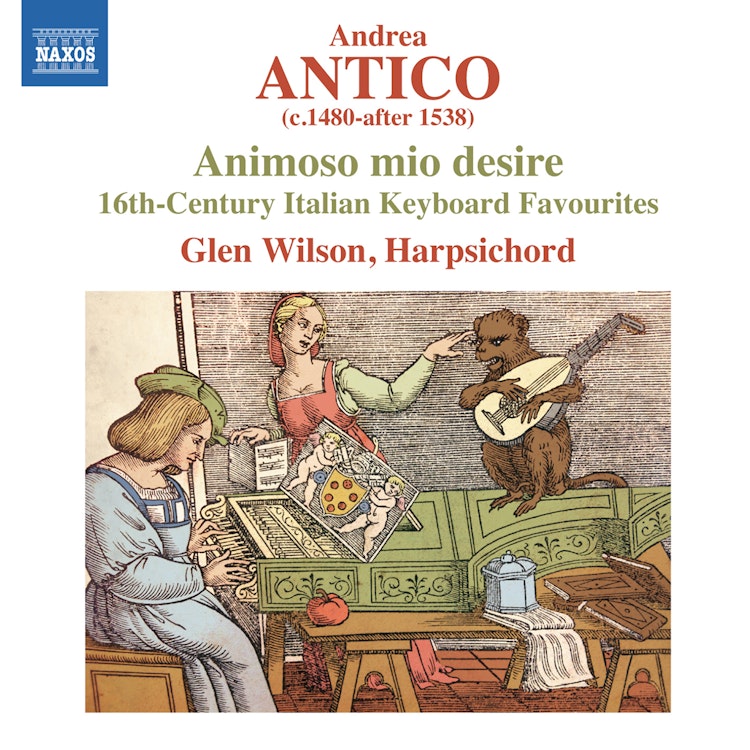
The album's cover image is a woodcut from Antico's 1517 print, depicting a girl waving away an angry ape (presumably Petrucci) and turning to Antico, who plays a Papal harpsichord.
Critical Reception
Antico's first keyboard music print was poorly produced, with indecipherable vertical alignment and numerous errors, typical of early attempts at printing keyboard music on two staves.
Composer Biography
Andrea Antico, a printer from Dalmatia, obtained a monopoly for printing keyboard music in 1517 from the first Medici Pope, Leo X, due to Petrucci's failure to publish such works.
Compositional Technique
The anonymous arranger of Antico's frottola collection created an early example of a fully-balanced polyphonic keyboard style, substituting supple inner voices for the original 'spiky' ones.
Cultural Impact
The frottola, a 16th-century Italian song form, influenced the 'Parisian' chanson after Charles VIII of France invaded Italy in 1494, leading to a fruitful cultural exchange.
Historical Context
During the mid-15th century Italian Renaissance, native musical composition in Italy was strangely silent, as humanism turned musicians away from the dominant Franco-Netherlandish style.
You might also enjoy...
Pachelbel: Complete Keyboard Music, Vol. 1
Couperin, L.: Tombeau De M. De Blancrocher / Preludes
French Music On Two Harpsichords (Musique Française À Deux Clavecins)
Le clavecin moderne: New Polish Music for the Harpsichord Solo
Mattheson:12 Suites for Harpsichord
Marais: Dans les jardins d'Eurytus
Cabezon, A. / Ximenez / Coelho / Carreira / Cabezon, H. / Cabanilles: Keyboard Works
D'Anglebert, J.-H.: Harpsichord Suites and Transcriptions
Rameau: Symphonies for two harpsichords / à deux clavecins
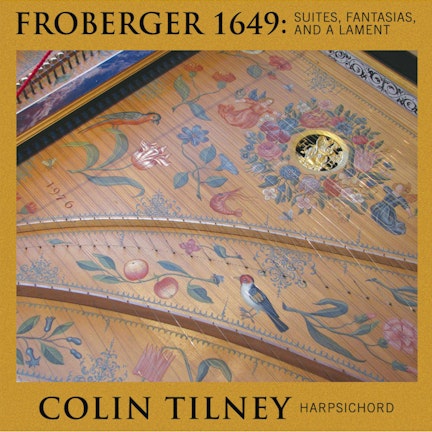
Froberger 1649: Suites, Fantasia and a Lament
Couperin: Deuxième livre de pièces de clavecin, Ordre 8
Coelho: Flores de Musica pera o Instrumento de Tecla, & Harpa, Vol. 4