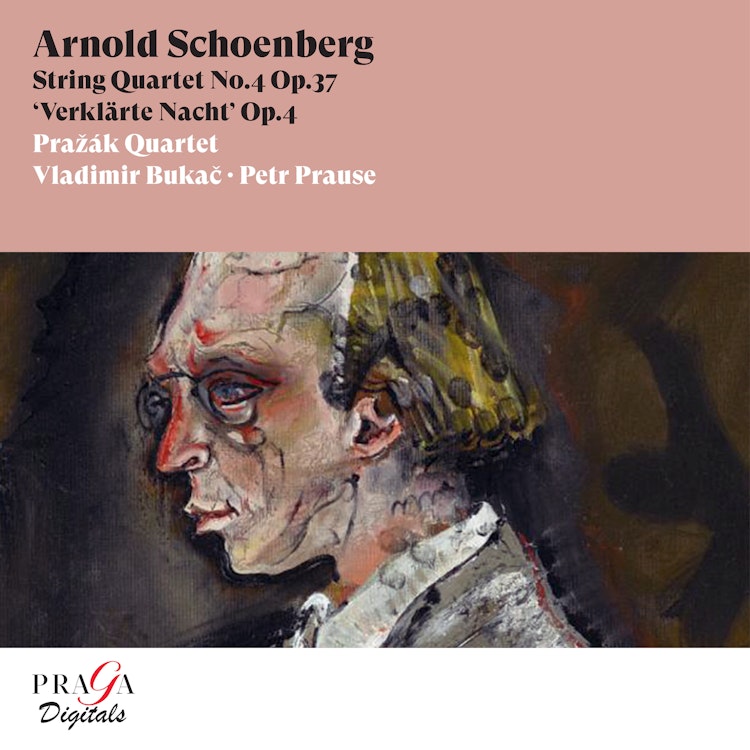
Arnold Schoenberg: String Quartet No. 4 & Verklärte Nacht
3/1/2007, 9 Tracks, 58:38
Featuring
Václav Remeš
Vlastimil Holek
Josef Klusoň
Michal Kaňka
Vladimír Bukač
Petr Prause
Pražák Quartet
Arnold Schoenberg
Did you know?
1/7
Historical Context
Schoenberg composed his String Quartet No. 4 in 1936 while exiled in Los Angeles, having been driven from Europe by the active anti-Semitism of Hitler's regime.
Composition History
Arnold Schoenberg composed the string sextet 'Verklärte Nacht' in less than three weeks during the summer of 1899, inspired by a poem by Richard Dehmel.
Instruments
The violist Vladimír Bukač plays an instrument made by Lorenzo Guadagnini of Cremona, circa 1742, while cellist Petr Prause plays one made by Giovanni Gagliano in 1795.
Critical Reception
Schoenberg's 'Verklärte Nacht' was initially met with a "totally negative" judgment from a jury member, who compared it to a "still-damp score of Tristan."
Performer Biography
The Pražák Quartet, like many Bohemian ensembles, was founded while its members were students at the Prague Conservatory (1974-78) and won the First Prize at the Evian International Competition in 1978.
Composer's Artistic Vision
Schoenberg stated that his 'Transfigured Night' drew inspiration from both Wagner, for its thematic development, and Brahms, for its technique of 'development through continuous variation'.
Composer's Artistic Vision
Schoenberg emphasized to his students that his use of series was a "method and not a system," and that his works were "essentially works of the imagination and not... mathematical constructions."
You might also enjoy...
Ravel: String Quartet - Stravinsky: Three Pieces for String Quartet
Berg: String Quartet, Op. 3 & Lyric Suite
Sergei Prokofiev, Alexander Borodin, Pyotr Ilyich Tchaikovsky: Russian String Quartets