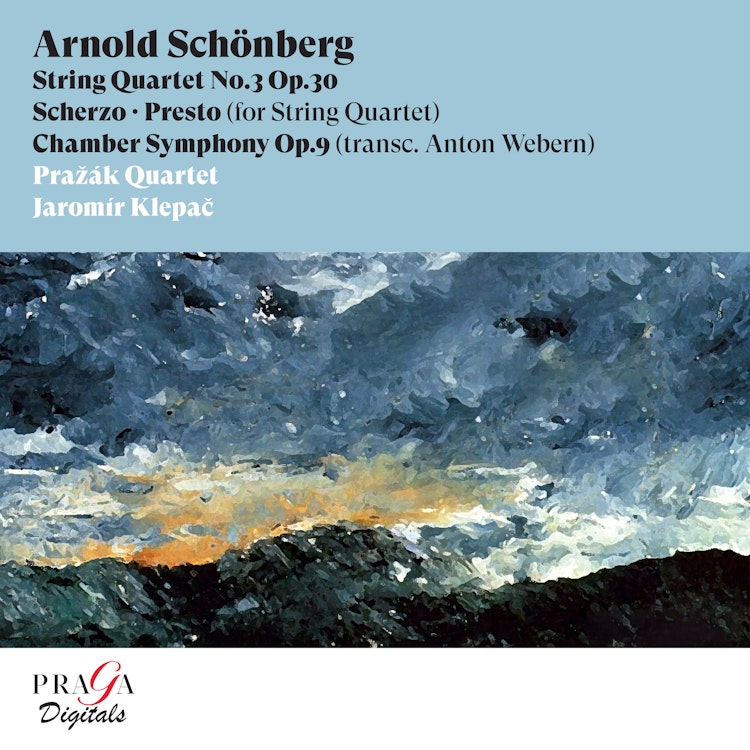
Arnold Schönberg: String Quartet No. 3, Scherzo, Presto, Chamber Symphony
12/1/2010, 7 Tracks, 1:04:26
Featuring
Pavel Hůla
Vlastimil Holek
Josef Klusoň
Michal Kaňka
Jaromír Klepáč
Pražák Quartet
Arnold Schoenberg
Did you know?
1/7
Performer Biography
The Pražák Quartet, an international chamber music ensemble, was founded in 1972 by students at the Prague Conservatory and has won first prizes at the Prague Conservatory Chamber Music Competition and the Evian String Quartet Competition.
Composer Biography
Arnold Schönberg, the composer, wrote to Rudolf Kolisch in 1932, cautioning against overestimating analyses that focus on 'how it is done' rather than 'what it is'.
Notable Performances
The original version of Schönberg's Chamber Symphony, Op. 9, was premiered on February 8, 1907, in Vienna by the Rosé Quartet and the Society of Soloists of the Wiener Philharmoniker.
Composition History
Schönberg's Scherzo in F major, composed in 1896, was not published until 1966, despite being warmly received by Viennese critics who hailed him as 'a new talent' and 'a new Mozart'.
Compositional Technique
Schönberg's Chamber Symphony, Op. 9, uses a series of six-note chords at intervals of fourths as its main thematic material, which plays an architectural role throughout the work.
Composition History
Schönberg's String Quartet No. 3, Op. 30, was his last 'European' score, composed in Vienna in early 1927 and commissioned by American arts patron Elizabeth Sprague Coolidge.
Compositional Technique
In his Third Quartet, Schönberg employs contrapuntal processes like inversion, retrograde, augmentation, and diminution, often combined, leading to his 'serial' method of composition, where a theme is never repeated literally.
You might also enjoy...
Béla Bartók: String Quartets Nos. 3 & 4 - Leo Weiner: String Quartet No. 3
Prezioso String Quartet
Quartetto Italiano: The complete RIAS Recordings
Mendelssohn: String Quartet No. 1 in E-Flat Major, Op. 12 - String Quartet No. 2 in A Minor, Op. 13 - Capriccio, Op. 81, No. 3
WHAT IS AMERICAN
Primrose Quartet play Beethoven & Mozart
Ben Johnston: String Quartets Nos. 1, 5 & 10
Shostakovich: String Quartets, Vol. 3
Complete Mendelssohn Quartets
Haydn, Schumann, Brahms & Smetana: Chamber Works
Souvenir (Live)
Janáček: String Quartets & On an Overgrown Path, JW VIII/17