State Academic Symphony Orchestra of Russia “Evgeny Svetlanov”
Moscow Philharmonic Orchestra
Vyacheslav Petrovich Artyomov
Did you know?
1/7
Compositional Technique
Gurian Hymn uses an authentic West Georgian Easter song, "Christ has arisen" ('Agdgamasa Shensa'), as a cantus firmus in the deepest registers, forming the piece's foundation.
Composer Biography
Artyomov, along with composers Sofia Gubaidulina and Viktor Suslin, formed the improvisation group "Astreya" in 1975, which improvised on non-orchestral and exotic instruments.
Historical Context
Artyomov was blacklisted as one of the 'Khrennikov's Seven' at the Sixth Congress of the Union of Composers for participating in Western festivals, which deprived him of performances and earnings.
Composer Biography
Vyacheslav Artyomov's music was created under circumstances of official defamation and exclusion from livelihood in a totalitarian country, making its creation an extraordinary feat.
Composer's Artistic Vision
Artyomov considers music a science, alongside astrophysics, believing it exposes the profundity of the human spirit and its connection to the World's Soul (Anima Mundi).
Critical Reception
Nine years after blacklisting Artyomov, Tikhon Khrennikov, head of the Union of Composers, praised Artyomov's Requiem, stating it surpassed Requiems by Mozart and Verdi.
Composition History
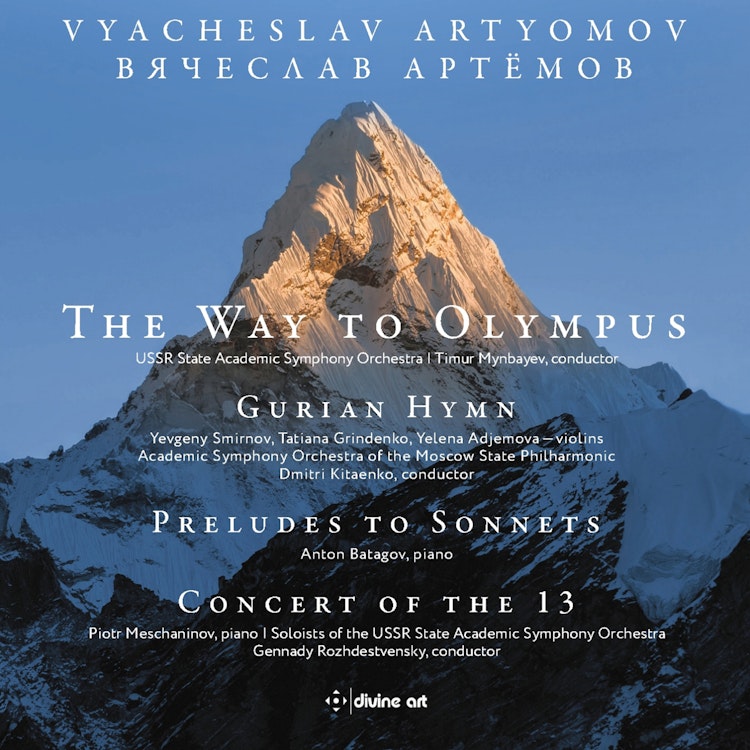
The Symphony: The Way to Olympus, conceived in 1978, is the first of four symphonies in the cycle "Symphony of the Way," on which Artyomov worked for over 30 years.
You might also enjoy...
Yoshimatsu: Cello Concerto / The Age of Birds / Chikap
James Willey: String Quartets
Concertos for Orchestra (Live)
Köhler: Alles Kapriolen
Lambert / Berners: Film Music - Merchant Seamen Suite / Anna Karenina Suite / Nicholas Nickleby Suite / Halfway House Suite
Hristic: The Legend of Orhid - Slavenski: Balkanophonia
Ole Bull Violin Concertos
Hughes: Anatiomaros
Philip Sawyers Concertos & Orchestral Works
Tansman: Wind Concertos
Larsson, Wirén, Hedwall & Koch: Works for Orchestra