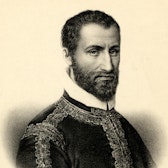
Giulio Caccini, a contemporary of Bassano, created songs for a single voice with theorbo accompaniment, focusing on speech rhythms and poetic sentiment rather than imitative vocal composition.
Interpretation
The performers believe that all diminutions, even those notated in the 16th century, should be seen as improvisations that happened to be written down, not as fixed works.
Compositional Technique
A key 16th-century musical practice was improvising virtuosic embellishments called "diminutions" or "divisions" on a single melody line from a polyphonic vocal piece.
Historical Context
In the Renaissance, flutes were made in families of different lengths to play polyphonic vocal music, as instrumentalists primarily imitated the human voice.
Instruments
The Haka flute, a Dutch flute from the 1660s, is tuned to be a late Renaissance flute, excelling in specific keys and having a magnificent sound that anticipates the 18th century.
Compositional Technique
Giovanni Bassano's Ricercata terza, a piece for a single melody instrument, uses imitative entries to suggest polyphony, leading to musically and technically challenging enormous intervals.
Historical Context
Before the early 18th century, the flute did not have a distinct identity or a dedicated repertoire, often being used interchangeably with other instruments.
You might also enjoy...
Biddington: Last Notes
Carosello di fantasie
Peter Hope: Wind Blown – Sonatas for Wind Instruments
Double Take: American Reed
Seducción
Hoffmeister's Magic Flute, Vol. 1 (Live)
Deussen, N.B.: San Andreas Suite / Appledorn, M.J. Van: Postcards To John / Trio Italiano
Schubert-Ellington
Schickele: A Year in the Catskills
Lake Reflections - Music for Flute & Harp
Bentzon, J.: Racconti
Music Among Friends
Think Subtilior (Cercle des fumeux & Songs and Sounds)