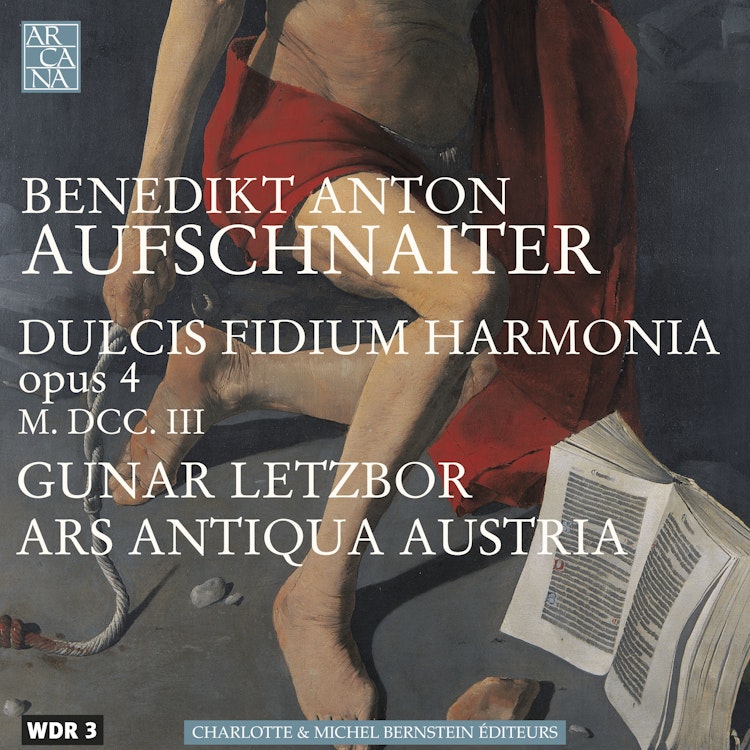
Benedikt Anton Aufschnaiter, the composer, likely received his musical education in Vienna and may have served the Viennese court, as suggested by a letter and a chronicler's description.
Composition History
Aufschnaiter's 'Dulcis Fidium Harmoniæ', Opus 4, consists of eight church sonatas published in Augsburg in 1703, a time when the sonata da chiesa was very popular.
Performer Biography
Gunar Letzbor, the director of Ars Antiqua Austria, was immediately enthusiastic about Aufschnaiter's music, finding its elaborate language and Austrian color captivating.
Compositional Technique
Unlike many contemporaries who used a four-movement form, Aufschnaiter's church sonatas, like those of the Viennese tradition (e.g., Bertali or Schmelzer), are mostly in one movement or bipartite.
Compositional Technique
Aufschnaiter's sonatas demonstrate his skill in counterpoint, employing baroque harmonic colors with Phrygian cadences and sudden major-minor shifts.
Cultural Impact
Despite the rapid development of music in his era, Aufschnaiter's compositions were still copied and performed in the late 18th century, indicating his lasting influence.
Composer's Artistic Vision
Aufschnaiter dedicated each of his sonatas in 'Dulcis Fidium Harmoniæ' to a specific saint, with the first four honoring Church Fathers and the last four honoring the Evangelists.
You might also enjoy...
Lebègue: Pièces de clavessin
Boismortier / Schickhardt / Telemann: Recorder Music
Alla Polacca: Polish Influences in Baroque Music
Marcello, A.: Oboe Concerto in D Minor / Telemann, G.P.: Oboe Concerto in F Minor / Handel, G.F.: Oboe Concerto No. 3