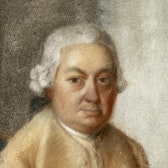
Carl Philipp Emanuel Bach, despite his growing international reputation as a keyboard composer, was not highly favored by his employer, Frederick II, who did not promote him beyond his role as keyboard accompanist.
Performer Biography
Miklós Spányi, the soloist on this recording, has concentrated his work as a performer and researcher on the oeuvre of Carl Philipp Emanuel Bach for several years and is preparing a complete edition of Bach's keyboard works.
Historical Context
In the mid-1750s, Berlin was a hub of musical activity, supported by Frederick II (Frederick the Great) and Prussian aristocrats, with active musical debates and publications.
Interpretation
The performer, Miklós Spányi, chose to record these 'organ' concertos on an early piano (tangent piano) due to evidence suggesting the composer's later revisions made them more suitable for stringed keyboard instruments.
Instruments
Princess Anna Amalia's organ, for which Carl Philipp Emanuel Bach composed several works, was unusually grand for a house organ, featuring 23 stops on two manuals and pedal, and a wide compass.
Composer's Artistic Vision
Carl Philipp Emanuel Bach diversified his compositions in the 1750s, including solo keyboard fugues, French-style character pieces, and minuets/polonaises for beginners, catering to a burgeoning amateur market.
Composition History
The designation of some of Carl Philipp Emanuel Bach's concertos for 'organ or stringed keyboard' was likely due to the specific circumstances of Princess Anna Amalia, Frederick II's sister, who had a new organ built in her Berlin residence.