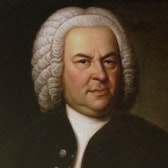
Bach's Orchestral Suite No. 4 in D major BWV 1069 reuses elements from the opening chorus of his cantata Unser Mund sei voll Lachens BWV 110, which was itself a reworking of a lost original.
Recording & Production
This album was recorded in February 2004 at L'Arsenal de Metz and in March and May 2010 at Temple Saint-Jean de Mulhouse.
Composer Biography
Bach's first biographer, Forkel, noted that he couldn't judge the effect of the Concerto for four harpsichords because he had never been able to gather the four instruments and performers required.
Composition History
The Concerto for Harpsichord, Strings and Continuo in E major BWV 1053 is a result of Bach's reuse and transformation of an earlier concerto, likely for oboe or flute, which he adapted for various cantatas before turning it into a harpsichord concerto.
Composer's Artistic Vision
Bach, like his contemporaries, adopted a decidedly French style in his Suites, banishing the German style and arranging pieces with great freedom, often evoking the grandeur of Versailles.
Album & Artwork
The album cover features an 18th-century oil painting titled "Portrait d'une femme tenant une tasse" (Portrait of a woman holding a cup) by an anonymous artist, housed in the Musée d'Art et d'Industrie in Roubaix.
Composition History
Bach's Concerto for four harpsichords, strings and continuo in A minor BWV 1065 is an adaptation of Vivaldi's Concerto for four violins, strings and continuo in B minor, Op. III No. 10 from L'Estro Armonico.
You might also enjoy...
Telemann: Concerto in D Major / La Bouffonne / Grillen-Symphonie / Alster Overture
J.S. Bach: Complete Concertos
Handel: Water Music/Music for the Royal Fireworks etc.
Ton Koopman Conducts Bach
Telemann, Conciertos II
The German Album
Bach Famous Pieces
Bach: Concerts avec plusieurs instruments (Vol. I à VI) - Intégrale
J. S. Bach: Concertos
Bach's Concertos for sundry Instruments - Bach at Zimmermann's Café
The Baroque Collection
The J.S. Bach Exercise Album
Telemann, G.P.: Overtures / Concertos / Chamber Music