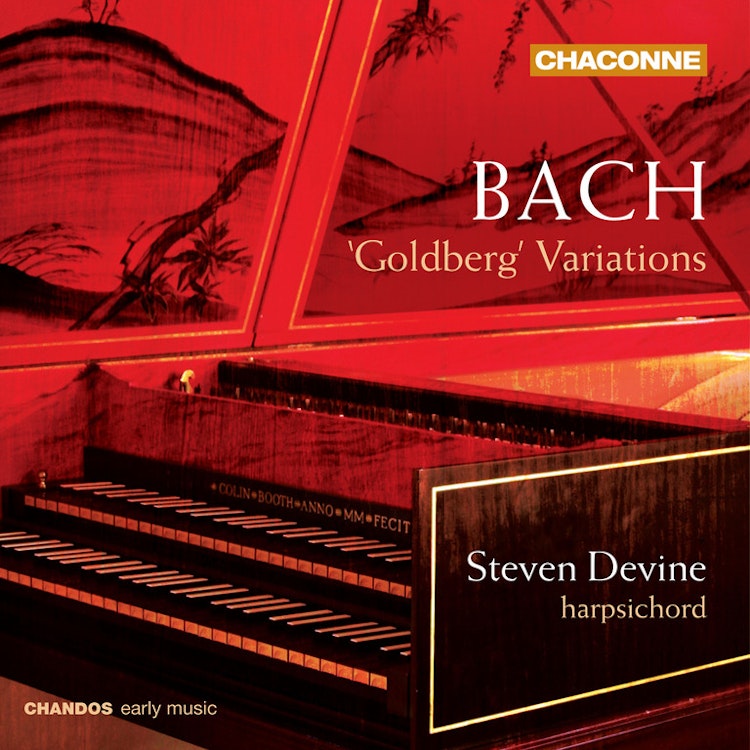
The popular story that Bach composed the Goldberg Variations for Count Kaiserling, a Russian Ambassador, to help him with sleepless nights, is likely a myth.
Composition History
The Goldberg Variations were published in 1741 as the fourth part of Bach's Clavier-Übungen (keyboard exercises), and the lack of a dedication casts doubt on the Kaiserling connection.
Performer Biography
Steven Devine, the harpsichordist on this recording, is also the co-principal keyboard player with the Orchestra of the Age of Enlightenment.
Compositional Technique
Every third variation in the Goldberg Variations is a canon at an increasing interval, with the exception of Variation 30, which is a Quodlibet.
Compositional Technique
The Goldberg Variations are structured with an Aria, followed by thirty variations, and a reprise of the Aria at the end.
Compositional Technique
The Quodlibet (Variation 30) in the Goldberg Variations incorporates at least two popular folk tunes that contemporary listeners would have recognized.
Composition History
It is unlikely that the young Goldberg, born in 1727, could have played the technically demanding variations at age twelve or thirteen, suggesting Bach composed the piece for his son, Wilhelm Friedemann.
You might also enjoy...
Couperin: The Complete Pièces de clavecin, Vol. 7
J.S. Bach: Goldberg-Variationen BWV 988
J.S. Bach: Goldberg Variations, BWV988
Corrette: Premier Livre de Pièces de Clavecin
Couperin: L'art de toucher le clavecin
Frescobaldi: New Musicological Edition
Galuppi: 8 Sonatas for Harpsichord & Organ
Clavecin soleil - The Sun King's Harpsichordists
J.S. Bach: The Six Partitas
Johann Sebastian Bach: The Six Partitas, Bwv 825 830