In Bach's time, the practice of 'figural passion music' — combining gospel text recitation with free arias and choruses — was controversial, with some contemporaries viewing it as too much like 'sacred opera'.
Compositional Technique
The St. John Passion's original orchestra included almost every conceivable instrument, except for brass instruments, which were considered unthinkable in passion music.
Composition History
Bach attempted to create a final score for the St. John Passion around 1739, but this fair copy remained a torso, not progressing beyond the first ten movements.
Composition History
Bach revised the St. John Passion multiple times, including a substantially altered version in 1725 where he added new arias and replaced choruses.
Interpretation
In his last documented performance of the St. John Passion, Bach experimented with a performance practice closer to that of the 19th century, where soloists for dramatic roles were separated from the choir.
Composition History
J. S. Bach was obliged to deliver a musical rendition of one of the four biblical passion narratives for the vespers service on Good Friday each year.
Composition History
Bach's contract as Kantor of St. Thomas in 1723 stipulated that his music should not be too long or 'operatic in nature,' but rather encourage devotion.
You might also enjoy...
Bach: St. John Passion
Bach St Matthew Passion (abridged)
Bach: St. John Passion
J.S. Bach: St. Matthew Passion, BWV 244b
Bach: St.Matthew Passion
St Matthew Passion - Bach
Handel: Brockes Passion, HWV 48
Bach, JS : St Matthew Passion [2001]
Keiser: Brockes-Passion
Bach: St. John Passion (Selection)
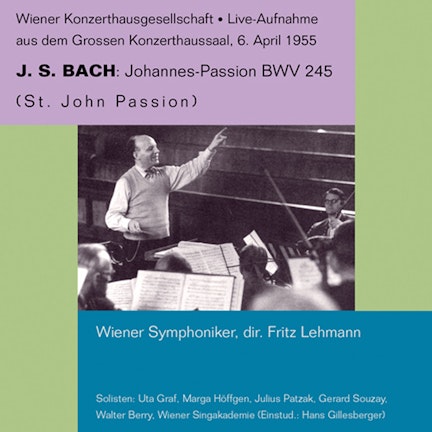
Bach: Johannes-Passion/St. John Passion, BWV 245
J.S. Bach: St. Matthew Passion (Recorded 1993)
Bach, J.S.: St. Matthew Passion - Arias & Choruses