One theory suggests Bach created these masses not for immediate performance, but to compile and preserve important parts of his cantatas in a new way, making the music applicable beyond his professional sphere.
Composition History
Bach's four masses were likely intended for liturgical use, unlike his larger Mass in B minor, but their exact purpose and liturgical background remain a mystery.
Composition History
Bach sent these four masses, composed around 1737 or 1738, to the Catholic court of Dresden, even though Protestant services were also held there.
Recording & Production
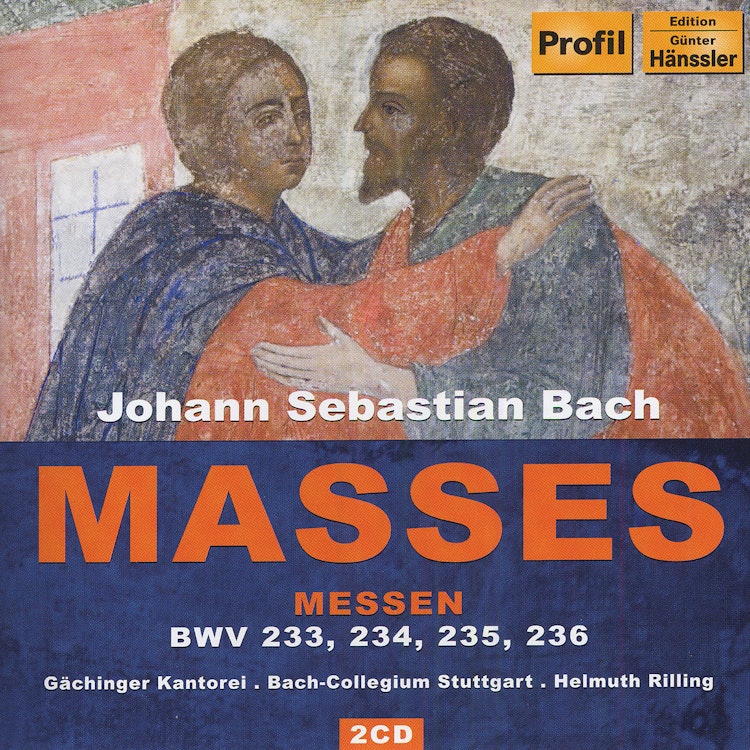
This recording of Bach's four masses was made in Stuttgart in 1967.
Performer Biography
Helmuth Rilling, the conductor on this album, founded the Gächinger Kantorei in 1954, the Bach-Collegium Stuttgart in 1965, and the International Bach Academy of Stuttgart in 1981.
Compositional Technique
These masses are sometimes called "Protestant" or "Lutheran masses" because they only consist of a short Kyrie and a long, five-part Gloria, omitting other parts of the Ordinary like Credo, Sanctus, and Agnus Dei.
Compositional Technique
Bach compiled these masses by borrowing almost all the music from his existing cantatas, replacing the original German sacred texts with Latin mass texts.
You might also enjoy...
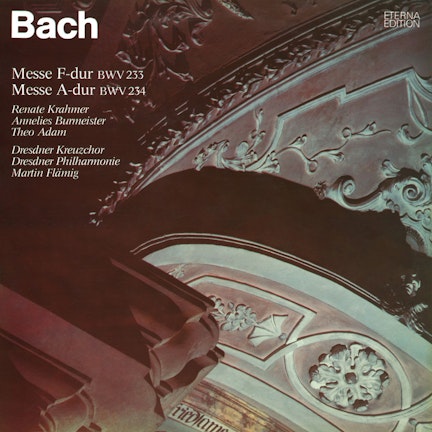
Bach: Messe F-Dur & Messe A-Dur
Johann Michael Haydn: Messe für Frauenchor
Messen für Frauenchor
Bach - Mass in B minor
Vivaldi: Magnificat/ Gloria
Daser: Missa Pater noster: IV. Sanctus: a. Sanctus
Mozart: Missa Brevis - Regina Coeli
Mozart: Requiem; Great Mass in C minor; Missa brevis in C major