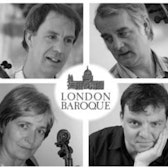
London Baroque, formed in 1978, is recognized as a leading exponent of baroque chamber music, performing around 50 concerts annually and having appeared on television in many countries.
Interpretation
London Baroque, the ensemble performing on this album, has re-transcribed Bach's organ trios for the classical scoring of two violins and continuo, adhering to the spirit of the works.
Composer's Artistic Vision
Throughout his life, Johann Sebastian Bach arranged and transcribed his own and others' works, not from dissatisfaction, but from a desire to explore every musical and structural possibility of an idea.
Composition History
Many of Bach's well-known pieces are arrangements or transcriptions of earlier works, or were used as a basis for further transcriptions.
Interpretation
For Sonatas No. 2 and 4, the second part is played on a viola, as it fits perfectly on the instrument, reflecting Bach's own unconventional approach to instrumentation.
Compositional Technique
The organ trios are written in the classical trio sonata form, featuring two equal melody lines and a bass, and synthesize different styles from old-fashioned fugues to galant allegros.
Composition History
The six organ trios were compiled by Bach for his oldest son, Wilhelm Friedemann Bach, to prepare him to become a great organist.
You might also enjoy...
The Trio Sonata in 18th-Century Germany
Handel: Seven Trio Sonatas, Op. 5
Telemann: 6 Trios
Telemann: Six Trio 1718
The Trio Sonata in 18th-Century France
Rameau: Pièces de clavecin en concert
Bach: Organ Trio Sonatas
Leclair: Sonates for Strings, Op. 4
To All Lovers of Musick
Rameau: Pieces de clavecin en concerts
Jean-Philippe Rameau: Pièces De Clavecin En Concerts