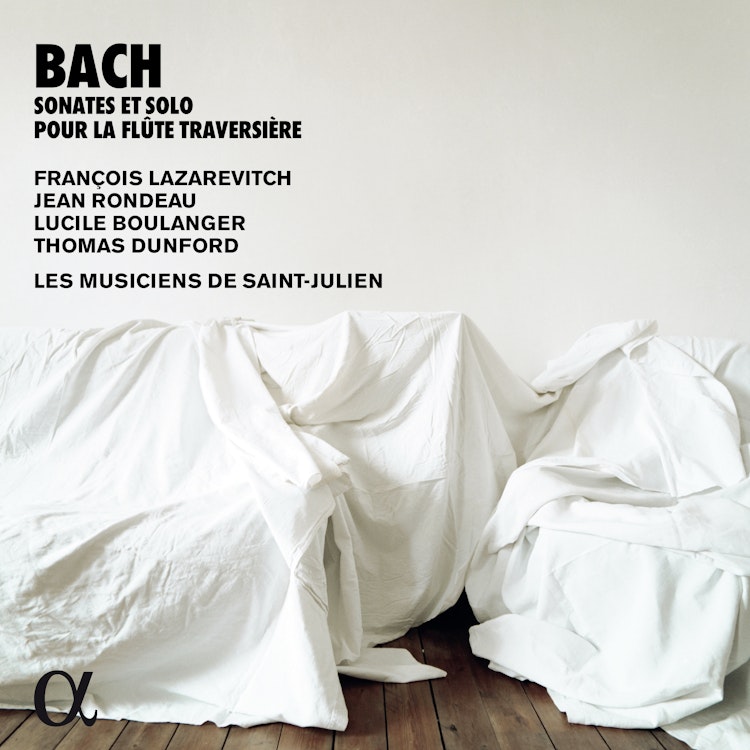
Bach: Sonates & solo pour la flûte traversière (Alpha Collection)
8/23/2019, 18 Tracks, 1:11:56
Featuring
François Lazarevitch
Jean Rondeau
Les Musiciens de Saint-Julien
Johann Sebastian Bach
Did you know?
1/7
Interpretation
The performers on this album draw on the Solfeggi Pour La Flute Traversiere avec l'enseignement Par Monsr. Quantz, a little-known source from the Royal Danish Library, to inform their interpretation of Bach's flute music.
Recording & Production
Stéphane Delplace created a reconstruction for this recording of the missing 46 bars from the second part of the opening Vivace in Bach's Sonata in A major, BWV 1032, as the autograph manuscript is incomplete.
Interpretation
The practice of 'unequal notes' is crucial for interpreting Bach's flute music, as Quantz, a contemporary flautist, advised against standardized articulation for short notes because it makes them 'all alike'.
Historical Context
Johann Joachim Quantz, a prominent German flautist from 1730-1750, met Bach multiple times in Dresden and Berlin and is considered a possible dedicatee of Bach's Solo pour la Flûte Traversière in A minor.
Compositional Technique
The Solfeggi by Quantz, a flautist who met Bach, emphasize articulation as a fundamental aspect of performance, with a rich variety of tonguings like 'ti', 'ri', and 'did'll' to create expressive musical discourse.
Interpretation
The Solfeggi, a collection of specific cases for flute playing, contain over forty indications for 'unequal playing', demonstrating the vitality of this practice in 18th-century Germany.
Interpretation
The interpretation of short notes in Bach's music can vary greatly, from 'equal' to 'very unequal', depending on the movement, style, tempo, and melodic context, according to the Solfeggi.
You might also enjoy...
Bach - Flute Sonatas
Aria
Gloria
Hotteterre: Music for Flute, Vol. 2 - Deuxieme Livre De Pieces