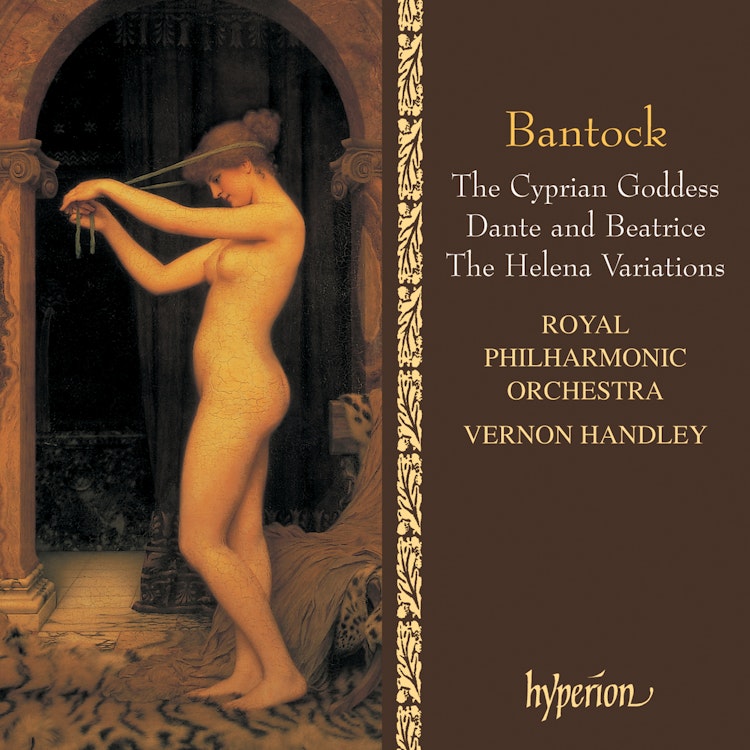
Bantock: The Cyprian Goddess; Helena Variations; Dante and Beatrice
7/28/2023, 19 Tracks, 1:09:25
Featuring
Vernon Handley
Royal Philharmonic Orchestra
Granville Bantock
Did you know?
1/7
Composer Biography
Sir Granville Bantock, the composer, was the son of a well-known surgeon and initially faced parental opposition to his musical aspirations, with his father planning careers for him in the Indian Civil Service or chemical engineering.
Composer's Artistic Vision
Bantock's Dante and Beatrice, a poem for orchestra, was revised in 1910 to be a 'psychological study' aiming to evoke states of mind rather than detail individual episodes from Dante's life.
Composer's Artistic Vision
Bantock's love for languages led him to study Latin, Greek, Persian, and Arabic, influencing works like The Pagan Symphony and The Cyprian Goddess, which draws on Horace's Odes.
Composition History
The Cyprian Goddess, Bantock's third symphony, was written while he was crossing the Pacific Ocean on an examining tour for Trinity College of Music, with the manuscript dated January 12, 1939, from Suva, Fiji.
Composition History
Bantock's Helena Variations were written in 1899, inspired by his wife Helena von Schweitzer's moods and dedicated to her, shortly after Elgar's Enigma Variations had caused a sensation.
Composer Biography
Bantock was an early advocate for Jean Sibelius, the Finnish master, and Sibelius's Third Symphony is dedicated to him.
Composer's Artistic Vision
Bantock was considered by Elgar to have 'the most fertile musical brain of our time' and was regarded as 'contemporary' by critics who saw him as more important than Elgar in the late 1890s and Edwardian period.
You might also enjoy...
Mahler: Symphony No. 1 in D Major / Ives: Central Park in the Dark
Devreese: Symphony No. 1 / Poeme Heroique
Devreese: Symphony No. 1 / Poeme Heroique
Casella: Orchestral Works
Holst: Orchestral Works, Vol. 4
Tschaikowsky: 4. Symphonie - Ljadow: 8 russische Volksweisen - Der verzauberte See
Scriabin, A.: Symphony No. 2 / Reverie / Le Poeme De L'Extase
Bax: Symphony No. 4, Nympholept & Overture to a Picaresque Comedy
Bax: Symphony No. 6 / Into the Twilight
Ives, C.: Universe Symphony (Completed by L. Austin) / Orchestral Set No. 2 / The Unanswered Question
Harty: Irish Symphony (An) / With the Wild Geese / In Ireland