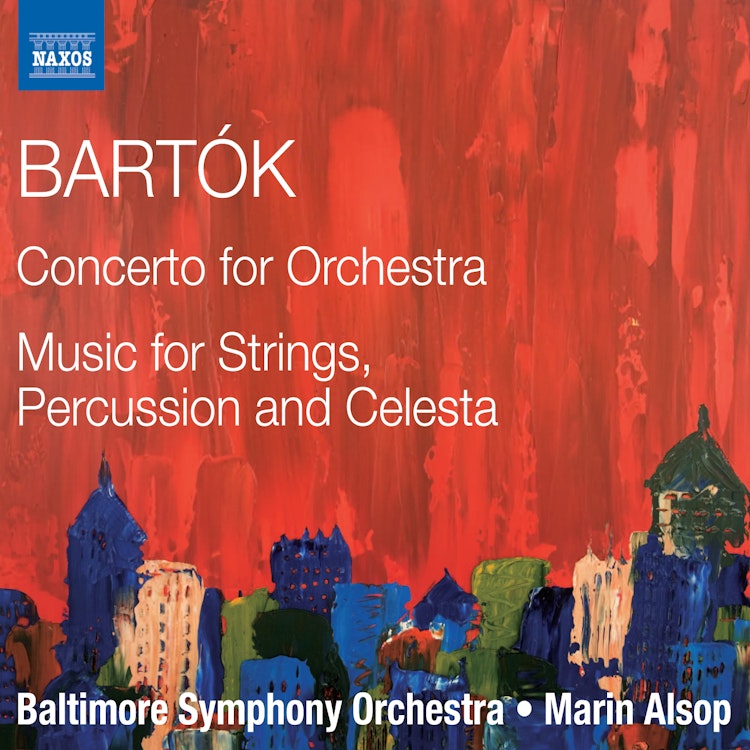
Bartók: Concerto for Orchestra, Sz. 116 & Music for Strings, Percussion & Celesta, Sz. 106
11/1/2012, 9 Tracks, 1:07:24
Featuring
Marin Alsop
Baltimore Symphony Orchestra
Béla Bartók
Did you know?
1/7
Historical Context
Bartók emigrated to the United States in 1940 due to dissatisfaction with the growing association between the Horthy government in Hungary and National Socialist Germany.
Composition History
Bartók's Music for Strings, Percussion and Celesta was commissioned in 1936 by Paul Sacher, founder and conductor of the Basle Chamber Orchestra.
Composer Biography
Béla Bartók, the Hungarian composer, developed a deep interest in the folk music of his own and adjacent countries, extending his research as far as Anatolia.
Compositional Technique
In the Concerto for Orchestra, Bartók parodies a fragment of Shostakovich's Seventh Symphony within the Intermezzo movement.
Performer Biography
Marin Alsop made history in 2007 by becoming the first woman to head a major American orchestra, the Baltimore Symphony Orchestra.
Compositional Technique
In Music for Strings, Percussion and Celesta, the first movement's string entries follow the circle of fifths, leading to a central climax on E flat.
Composition History
Bartók's Concerto for Orchestra was commissioned in 1943 by the Koussevitzky Music Foundation in memory of conductor Sergey Koussevitzky's wife, Natalie.
You might also enjoy...
Bartók: Orchestral Works
Bartók: Music for Strings, Percussion & Celesta, Sz. 106 and Concerto for Orchestra, Sz. 116
Bartók: Concerto for Orchestra/Music for Strings, Percussion & Celesta
Bartók: Music for Strings, Percussion and Celesta, Concerto for Orchestra
Bartok: Concerto for Orchestra / Music for Strings, Percussion and Celesta
Bartók: Orchestral Works
Bartók: Concerto for Orchestra, Four Orchestral Pieces & Hungarian Peasant Songs
Bartók: Concerto for Orchestra; Music for Strings, Percussion & Celesta; Hungarian Sketches