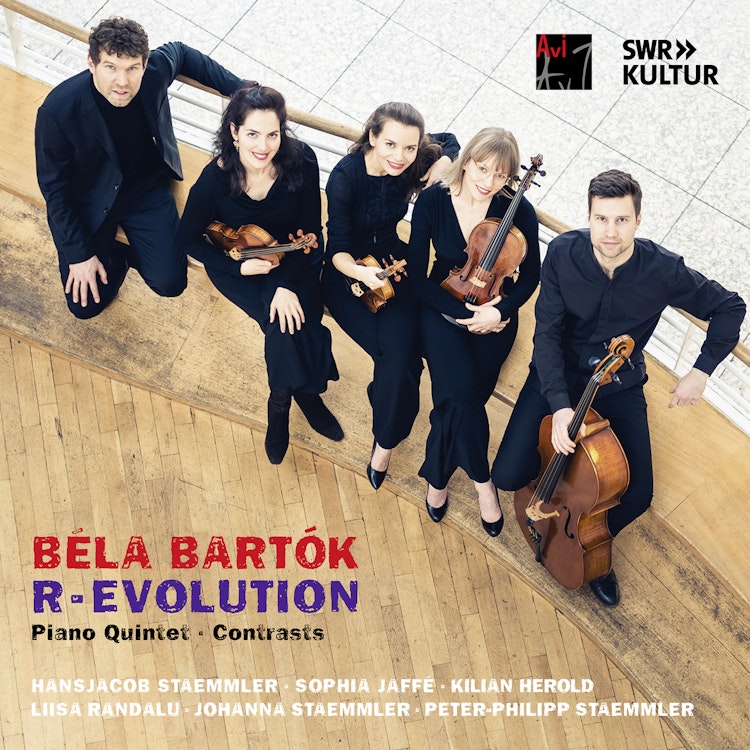
Bartók: Piano Quintet in C Major; Contrasts for Clarinet, Violin & Piano
9/26/2025, 7 Tracks, 58:27
Featuring
Hansjacob Staemmler
Sophia Jaffé
Johanna Staemmler
Liisa Randalu
Peter-Philipp Staemmler
Kilian Herold
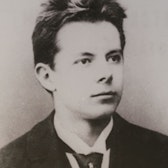
Béla Bartók
Did you know?
1/7
Composer Biography
Béla Bartók was a declared opponent of Italian fascism and German National Socialism, which led him to emigrate to the United States in 1940.
Compositional Technique
Bartók's 'Contrasts' incorporates jazz echoes and reveals his appreciation for George Gershwin, while also featuring Hungarian folk dance titles like 'Verbunkos' and 'Sebes'.
Composer's Artistic Vision
Béla Bartók, in a 1943 Harvard lecture, defined 'revolution' in art as 'destruction of all that existed before and a beginning anew,' but considered it 'impossible' and 'undesirable.'
Compositional Technique
Bartók's Piano Quintet shows the influence of Brahms and Liszt, with its opening referencing Brahms's Piano Quintet in F Minor and its use of a monothematic approach similar to Liszt.
Composer's Artistic Vision
Bartók viewed 'evolution' in art as 'gradual change' and considered the music of Schoenberg and Stravinsky to be evolutionary, a concept he also applied to his own works.
Composition History
Bartók's 'Contrasts' for Violin, Clarinet, and Piano was commissioned by renowned jazz clarinettist Benny Goodman through the intermediary of violinist Joseph Szigeti.
Composer Biography
Béla Bartók spent his final years in exile in the United States, marked by financial worries and illness, and never returned to his homeland before his death in New York in 1945.
You might also enjoy...
Sibelius: Piano Quintet / Svartsjukans Natter / Andante - Allegro / O, Om Du Sett / Vivace
Gaubert: Works for Flute, Vol. 1
Boris Tchaikovsky: Piano Quintet & The War Suite
Concert de Chausson - Quintette de Vierne
Korngold: Suite, Op. 23 & Piano Quintet, Op. 15
Dohnanyi: Piano Quintets Nos. 1 and 2 - Kodaly: Serenade
Perosi: Piano Quintet No. 1 in F Major, Piano Quintet No. 2 in D Minor & String Trio No. 2 in A Minor