Beethoven: 6 Bagatelles & Piano Sonatas Nos. 31 & 32
3/1/2019, 11 Tracks, 1:02:53
Featuring
Yevgeny Sudbin
Ludwig van Beethoven
Did you know?
1/7
Composer's Artistic Vision
Beethoven's late works, including those on this album, are characterized by his ability to condense intense thought and brief musical utterances into breathtaking musical significance.
Compositional Technique
The second movement of Beethoven's Sonata No. 31, Op. 110, incorporates melodies from two popular German songs: 'Unsa Kätz häd Katz'ln g'habt' (Our cat had kittens) and 'Ich bin lüderlich, du bist lüderlich' (I'm a slob, and so are you).
Performer Biography
Yevgeny Sudbin, the pianist on this recording, was born in St Petersburg and began his musical studies at the age of five, later moving to Germany and then London for further education.
Compositional Technique
Beethoven's Sonata No. 31, Op. 110, features themes derived from the hexachord (the first six notes of a diatonic scale) and often begin with a phrase covering the range of a sixth.
Composer Biography
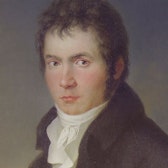
Ludwig van Beethoven, the composer, once asserted his unique genius to his patron Prince Lichnowsky, stating, "There are and will be a thousand princes; there is only one Beethoven!"
Compositional Technique
Beethoven's Sonata No. 32, Op. 111, employs a technique of 'rhythmic diminution' in its variations, progressively doubling the number of notes in each beat, which some say anticipates jazz improvisation.
Composition History
Beethoven's Sonata No. 31, Op. 110, is part of a triptych of his last three sonatas, composed and worked on in parallel between 1820 and 1822.