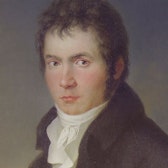
Beethoven's hearing began to deteriorate in 1796, and by 1801, his impairment was advanced enough to affect his social life, though it took over a decade to hinder his performing career.
Compositional Technique
The 'Gassenhauer' nickname for Beethoven's Trio Op.11 refers to the popular success of the variation theme, 'Pria ch'io l'impegno,' from Joseph Weigl's opera.
Composer's Artistic Vision
In his later years, Beethoven was annoyed by the continuing popularity of his Septet Op.20, feeling it overshadowed his more novel compositions, and reportedly wished it were burned.
Composer's Artistic Vision
Beethoven later expressed dissatisfaction with the light-hearted variation theme in his Trio Op.11 and wished to compose a new, more serious finale.
Composition History
Beethoven's Trio Op.11 was likely written at the request of clarinettist Joseph Bähr, who also suggested the theme for the variation movement.
Instruments
The clarinet of the late 18th century had only five keys, making it challenging to play in keys other than the instrument's designed key, most commonly B-flat major.
Composition History
Beethoven's Trio Op.38 is his own arrangement of his highly popular Septet Op.20, created to allow performance by smaller ensembles.
You might also enjoy...
Beethoven: Quintet for Piano and Winds in E-Flat Major, Op. 16 & Trio in B-Flat Major, Op. 11
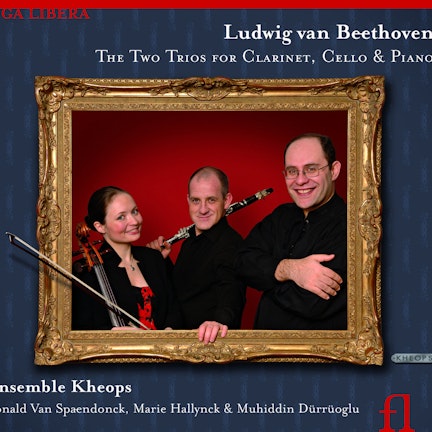
Beethoven: The Two Trios for Piano, Clarinet & Cello
Beethoven: The Two Trios for Piano, Clarinet & Cello
Beethoven, L. Van: Clarinet Trios
Beethoven: Clarinet Trios
Piano Trio, Op. 11; Quintet for Piano and Winds; Kakadu Variations
Beethoven: Piano Trios; Variations, Vol. II
Beethoven: The Complete Piano Trios for Piano, Violin and Cello
Beethoven, L. Van: Piano Quartets, Woo 36
Beethoven: Piano Trios 5-7, 9 & Variations on an Original Theme