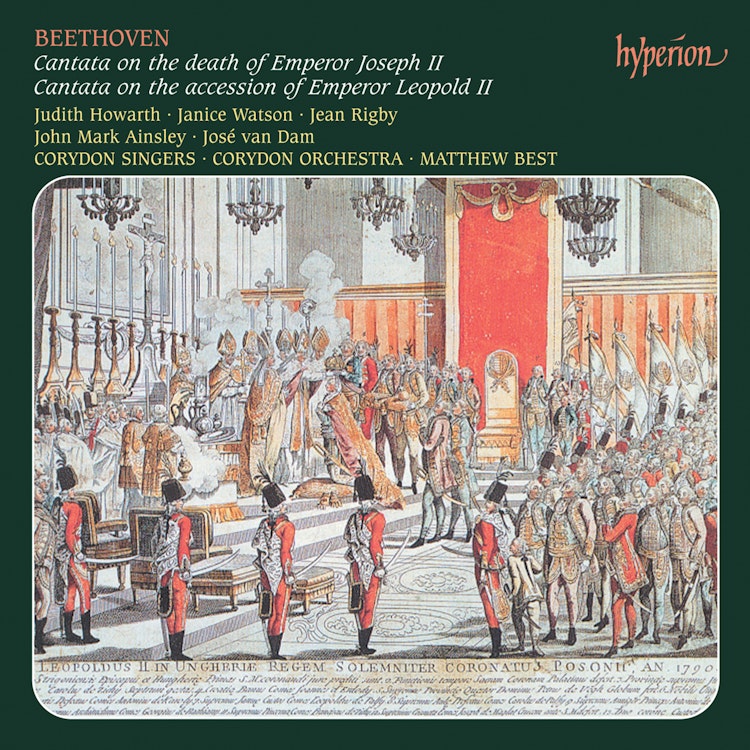
Beethoven: Early Cantatas: Cantata for Joseph II; Cantata for Leopold II etc.
9/29/2023, 14 Tracks, 1:19:43
Featuring
Janice Watson
Jean Rigby
John Mark Ainsley
José van Dam
Matthew Best
Judith Howarth
Roger Smith
Corydon Singers
Corydon Orchestra
Ludwig van Beethoven
Did you know?
1/7
Composer's Artistic Vision
Beethoven had a high regard for Johann Wolfgang von Goethe, the poet whose texts he set for Meeresstille und Glückliche Fahrt, and sought his help in raising subscriptions for the Missa solemnis.
Compositional Technique
Beethoven's setting of Goethe's 'Meeresstille und Glückliche Fahrt' uses extreme musical contrasts, such as the frenetic 'Glückliche Fahrt' contrasting with the rapt stillness of the opening, achieved through idiosyncratic scoring and slow-moving harmonies.
Composer Biography
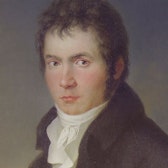
Beethoven's birthplace, Bonn, was under Viennese dominion, and his connection to the city was strengthened when Maximilian Franz, brother of Emperor Joseph II, became the Elector of Cologne in Bonn.
Notable Performances
Neither of Beethoven's cantatas on this album, the Cantata on the death of Emperor Joseph II nor the Cantata on the accession of Emperor Leopold II, were performed during his lifetime.
Composition History
The Lesegesellschaft (Reading Society) in Bonn commissioned Beethoven to set a text by Severin Anton Averdonk commemorating Emperor Joseph II's death.
Historical Context
The death of Empress Maria Theresia in 1780 and the succession of her son Joseph II led to a decade of enlightened reform in Vienna and the Holy Roman Empire.
Critical Reception
Johannes Brahms, after studying the rediscovered score of the 'Joseph' Cantata in 1884, wrote to Eduard Hanslick, saying: 'Even if there were no name on the title page, none other could be conjectured—it is Beethoven through and through!'
You might also enjoy...
Thomanerchor Leipzig: Weihnachtsliederabend
Ite ad Joseph
Choral Music - Bainton, E. / Thompson, R. / Mozart, W.A. / Casals, P. / Mendelssohn, Felix / Parry, H. / Durufle, M.
Into the House and Gate of Heaven
Elegy
Christmas at America's First Cathedral
Winter
Sacred: Inspirational and Spiritual Music for Choir and Orchestra
Josef Gabriel Rheinberger: Musica sacra
Rheinberger: Musica Sacra
Sing We Noel
Choral Music - Palestrina, G. / Bruckner, A. / Faure, G. / Holst, G. / Durufle, M. / Schubert, F. / Victoria, T.