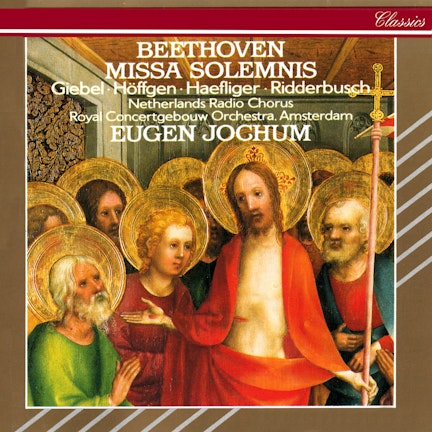
The Missa Solemnis took until December 1822 to complete, missing the Archduke's enthronement in March 1820 because each movement grew larger than originally planned.
Composer's Artistic Vision
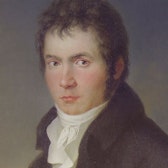
Beethoven, though not fond of organized religion, was a deeply religious man who believed in God as an all-powerful, loving Father, which he expressed in the Missa Solemnis.
Compositional Technique
The Missa Solemnis is not divided into separate numbers but composed as five symphonic movements, with soloists representing individuals and the choir representing humanity.
Composition History
Beethoven began composing the Missa Solemnis for the enthronement of his friend and patron, Archduke Rudolf of Austria, as Archbishop of Olmütz.
Performer Biography
Christoph Eschenbach, the conductor on this album, was mentored by famous conductors George Szell and Herbert von Karajan.
Notable Performances
The first performance of the Kyrie, Credo, and Agnus Dei from the Missa Solemnis in Vienna took place on May 7, 1824, in the same concert that introduced Beethoven's Ninth Symphony.
Compositional Technique
Beethoven's Missa Solemnis demands extreme vocal ranges and rhythmic precision from its singers, often straining all four sections of the choir.