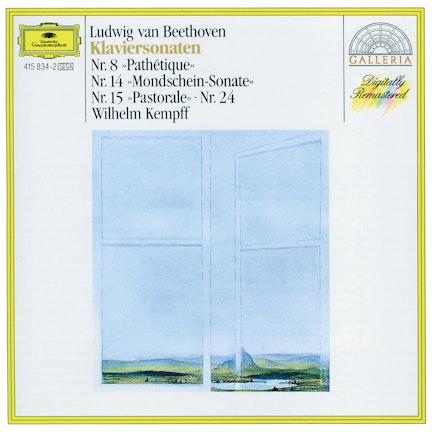
The title 'Grande sonate pathétique' for Beethoven's Piano Sonata Op. 13 likely did not originate with Beethoven himself, though he may have approved it.
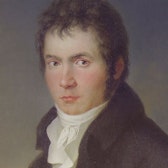
Composer Biography
Steven Osborne, the pianist on this recording, is one of Britain's most highly regarded pianists, having won a Gramophone Award in 2009 and first prize at the Naumburg International Competition and Clara Haskil Competition.
Instruments
For his 'Waldstein' Sonata, Beethoven used a keyboard with an extended compass, reaching a major third higher than the five-octave range common since Mozart and Haydn's time.
Compositional Technique
The 'Moonlight' Sonata's opening movement includes the instruction 'senza sordino', which was Beethoven's way of indicating the use of the sustaining pedal to create a harmonically blurred, mysterious atmosphere.
Cultural Impact
The slow movement of Beethoven's 'Pathétique' Sonata, with its broad melody over a gently rocking inner voice, was admired and emulated by later composers like Schubert.
Composition History
The famous 'Moonlight' nickname for Beethoven's Piano Sonata Op. 27 No. 2 was given by poet and music critic Ludwig Rellstab, who imagined a boat on Lake Lucerne.
Compositional Technique
Beethoven's 'Pathétique' Sonata was innovative in its time for bringing back material from the slow introduction at crucial points during the Allegro movement.