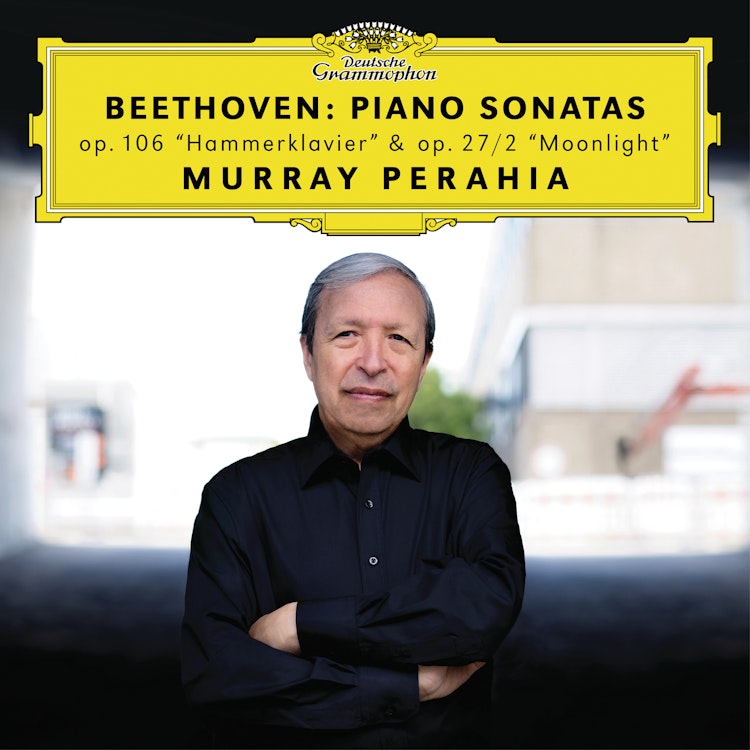
Winner of the Diapason d'or 2018 (Piano). ‘In terms of innovation, the “Hammerklavier” is still hard to get to grips with,’ says Murray Perahia of Beethoven’s grandest and most ambitious sonata, completed in 1818 and conceived specifically to push the newest piano of the time – imported from London – to its very limits. On his new Deutsche Grammophon release the great pianist, winner of Gramophone’s instrumental Award in 2017, couples the ‘Hammerklavier’ with the ever-popular ‘Moonlight’ Sonata.
Unlike Beethoven’s final trilogy of sonatas, opp. 109, 110 and 111, the “Hammerklavier” is a lone peak. “It doesn’t fit with the others – it’s much bigger,” Murray Perahia comments, “and the language that’s used was so unique that he never returned to it. Even the sonata’s dimensions, at more than 40 minutes, were almost unheard of at that time.
“In terms of innovation, the ‘Hammerklavier’ is still hard to get to grips with today,” he says. “Beethoven himself predicted that 50 years later people would be sweating over it. Its slow movement is one of the longest written up to then, and one of the saddest, while the complexity of the last movement’s fugue could sound modern even now…The challenge of this music is still alive because one can get deeper and deeper into the piece’s mysteries. That’s endless – both musicologically and emotionally. Everything in it is connected. There isn’t a random note, yet it feels improvisatory. So it’s a mystery that will intrigue and occupy musicians forever.”
“Hammerklavier” refers to a new type of piano that the instrument-makers Broadwood in England had sent to the composer, spurring him into action. “Beethoven was always looking for a symphonic equivalent in the piano – bigger, more sonorous, more orchestral,” says Perahia, “and I think he finally found something close to it, though he was never completely satisfied. This instrument gave him more notes, a broader sound and more pedal to sustain it.”
In contrast, the “Moonlight” Sonata’s subtitle has often been considered irrelevant to Beethoven’s intentions. But Perahia, who has been preparing new editions of the sonatas for Henle, has revelatory light to shed on this work: “The title came from a description by Ludwig Rellstab, a friend of Beethoven’s,” he says. “His depiction of the first movement was of a moonlit lake far away in Switzerland, but then he suddenly mentions an Aeolian harp. I think this idea possibly came from Beethoven.
“An article appeared at the time Beethoven was beginning this sonata, in the journal Allgemeine musikalische Zeitung, devoted to the Aeolian harp.” This instrument resembles wind chimes, the sounds made by the movement of the wind – although Beethoven seems to have imagined it as an actual harp, reflected in the first movement’s continuous accompaniment. “It was a craze, being talked about in poetry and literature, because it was considered to be the way that God spoke. A copy of this article turned up with Beethoven’s handwriting on the back, saying he was purchasing an Aeolian harp.”
The sonata’s marking “quasi una fantasia” – like a fantasy – is equally crucial: “The first movement is a combination of fantasy and sonata, but so free that it is much more a fantasy. The three movements – the fantasy, the minuet and the finale – are unified by the presence, in different ways, of the upward-striving, three-note arpeggio.”
- Murray Perahia in conversation with Jessica Duchen. Courtesy of Deutsche Grammophon
Featuring
Murray Perahia
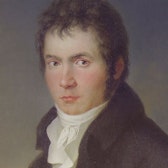
Ludwig van Beethoven
Did you know?
1/7
Composer's Artistic Vision
Beethoven may have been inspired by the Aeolian harp for his 'Moonlight' Sonata, Op. 27 No. 2, an instrument considered to be the 'voice of God' in poetry and literature of the time.
Composition History
The 'Moonlight' Sonata, Op. 27 No. 2, was given its popular title by Ludwig Rellstab, a friend of Beethoven's, who described the first movement as a moonlit lake.
Compositional Technique
The 'Hammerklavier' Sonata, Op. 106, is notable for its immense dimensions, lasting over 40 minutes, and its complex final movement fugue, which still sounds modern today.
Composition History
Beethoven's 'Hammerklavier' Sonata, Op. 106, was composed during a period of deep depression for the composer in 1817-1818.
Performer Biography
Murray Perahia, the pianist on this album, is renowned for his Beethoven performances and is preparing new editions of the sonatas for Henle.
Composer's Artistic Vision
The 'Moonlight' Sonata, Op. 27 No. 2, with its unusual C sharp minor key, represents the onset of Romanticism, drawing listeners towards something more mysterious and personal.
Instruments
The 'Hammerklavier' Sonata, Op. 106, was inspired by a new type of piano sent to Beethoven by the English instrument-makers Broadwood, which offered a broader sound and more notes.
Beethoven: Piano Sonatas No.13 In E Flat Major, Op. 27 No.1; No.14 In C sharp Minor "Moonlight", Op.27 No. 2; No.15 In D Major "Pastoral", Op. 28; No.26 In E Flat Major, Op. 81a "Les Adieux"