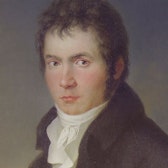
Beethoven's deafness, an ailment naturally fatal for a musician, was likely caused by regular consumption of poor-quality Hungarian wine containing lead.
Composer's Artistic Vision
Beethoven's personal notes, such as "Let your motivation lie in the deed and not in its outcome," reflect a philosophy of action without concern for reward, which the Quatuor Ysaÿe applies to their interpretation.
Composition History
Beethoven's 'middle period' quartets, including the three Op. 59 works dedicated to Prince Razumovsky, Op. 74, and Op. 95, were composed between 1806 and 1810.
Compositional Technique
Beethoven's sketchbooks for Op. 59 No. 1 show over a hundred melodic and rhythmic modifications for a cello theme, indicating his relentless effort to achieve vital energy in his music.
Interpretation
The Quatuor Ysaÿe's approach to Beethoven's string quartets emphasizes unity of expression over homogeneity of sound, a modern view of beauty as a result of musical thought.
Composer's Artistic Vision
Beethoven's late quartets, written during his final years, became his genre of choice, where he displayed boundless imagination and constantly reinvented musical forms.
Performer Biography
Miguel da Silva, the violist of Quatuor Ysaÿe, lived for thirty years within the "esoteric formation" of the string quartet, sometimes feeling like only a quarter of a voice.