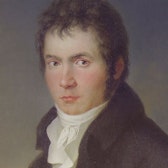
The 'Harp' Quartet, Op. 74, earned its nickname from the pizzicato arpeggios in the main theme of its Allegro movement, which Beethoven later used dramatically.
Composition History
Beethoven's original finale for the String Quartet No. 13, Op. 130, was the vast Grosse Fuge, but he replaced it with an "easier" finale at the urging of friends and his publisher, Artaria.
Instruments
The violinists of the Chiaroscuro Quartet play historical instruments: Alina Ibragimova uses a 1570 Andrea Amati violin, and Pablo Hernán Benedí plays a c. 1675 Nicolo Amati violin.
Performer Biography
The Chiaroscuro Quartet, formed in 2005, performs Classical and early Romantic music on gut strings and with historical bows, earning praise for its "authentic performance."
Critical Reception
Beethoven's 'Harp' Quartet, Op. 74, was considered a blend of the bizarre and fantastic by a contemporary critic, who also described its initial Adagio as having "unnecessary confusion of harsh dissonances."
Notable Performances
At the premiere of Beethoven's String Quartet No. 13, Op. 130, the audience encored the Presto and Alla danza tedesca movements, but not the challenging Grosse Fuge finale.
Composition History
Beethoven's String Quartet No. 13 in B flat major, Op. 130, was commissioned by Prince Nicholas Galitzin, a Russian amateur cellist and occasional composer, along with two other quartets.
You might also enjoy...
Beethoven: String Quartets, Vol. 4
Beethoven: String Quartets Nos. 12 & 14
Beethoven: String Quartets Nos. 12 & 14
Beethoven: String Quartet in E Flat Minor, Op. 127 & String Quartet in A Minor, Op. 132
Oistrakh Collection, Vol. 7: String Quartets
Beethoven: String Quartet No. 12 In E-Flat Major, Op. 127 & String Quartet No. 14 in C-Sharp Minor, Op. 131
String Quartets: E Flat Major Op. 127 - C Sharp Minor Op. 131
Mendelssohn Bartholdy: Sämtliche Streichquartette, Vol. 3.