Beethoven's Opus 18 quartets show him developing his unique voice, sometimes modeling his works on those of Mozart and Haydn, and frequently employing scholastic counterpoint.
Composition History
Beethoven composed his Opus 18 string quartets between 1798 and 1800, with the D major quartet being the first to be composed.
Instruments
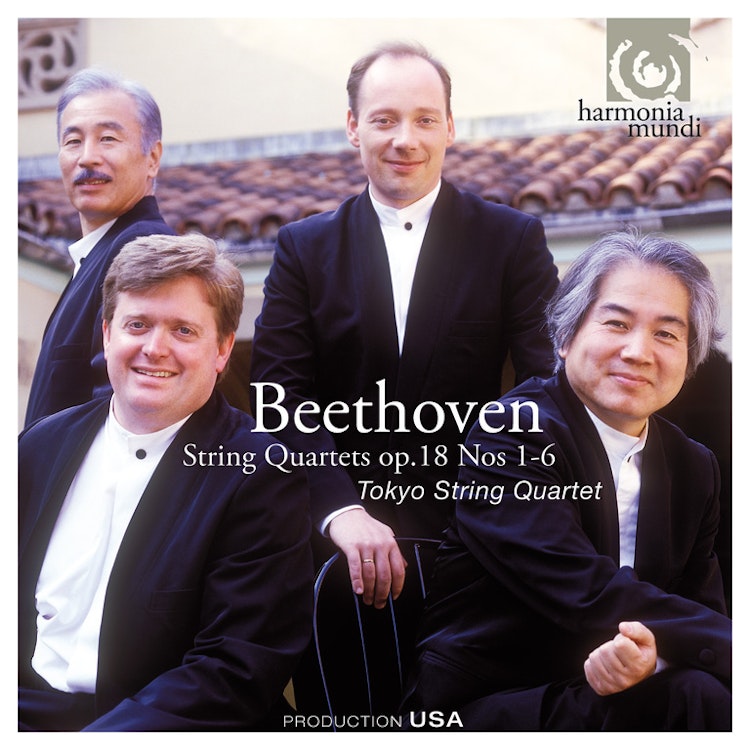
The Tokyo String Quartet performs on 'The Paganini Quartet,' a group of renowned Stradivarius instruments named after the legendary virtuoso Niccolò Paganini, who played them in the 19th century.
Performer Biography
The Tokyo String Quartet, formed in 1969, performs over a hundred concerts worldwide each season and has released more than 30 landmark recordings.
Composition History
The Opus 18 quartets were published in two volumes, four months apart, in 1801 by Tranquillo Mollo, a former colleague of Matthias Artaria, a leading music publisher.
Composer's Artistic Vision
The 'extra' movement, La Malinconia, in the B-flat major Quartet, is considered by some to be a bold extension of programmatic music into the string quartet genre, possibly linked to Beethoven's deafness crisis.
Critical Reception
La Malinconia, a movement in the B-flat major Quartet, is described as the most unusual and original among the Opus 18 Quartets, foreshadowing Beethoven's later major works like the Eroica Symphony.