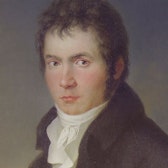
Beethoven composed his Symphony No. 2 shortly after a dramatic psychological breakdown related to his progressive deafness, which he documented in the 'Heiligenstadt Testament'.
Performer Biography
Kazimierz Kord, the conductor on this album, was the youngest director of an opera house in the world in 1962, leading the Cracow Musical Theatre to a prominent position in Poland.
Composer's Artistic Vision
Beethoven's 'Pastoral' Symphony, despite its programmatic titles, was intended to express emotions rather than paint literal pictures, as indicated by his note: 'More emotional expression, less tone-painting.'
Composition History
The autograph copy of Beethoven's Symphony No. 2 was lost because he lent it to his pupil Ferdinand Ries, who then lent it to a friend who never returned it.
Composition History
Beethoven's 'Heiligenstadt Testament', a document expressing his despair over his deafness, became a form of therapy that enabled him to overcome his weakness and continue composing with renewed energy.
Notable Performances
The premiere of Beethoven's Symphony No. 2 in 1803 was marred by intrigue: a rival theatre owner, Baron von Braun, organized a performance of Haydn's Creation on the same night with the best musicians to sabotage Beethoven's concert.
Notable Performances
The premiere of Beethoven's Symphony No. 6, the 'Pastoral', was part of an extremely long concert in 1808 that also included Symphony No. 5, Piano Concerto No. 4, and the Choral Fantasia, and was considered a 'total disaster' due to the demanding program and poor orchestral playing.
You might also enjoy...
Beethoven: Symphonies Nos. 1 & 8
Beethoven: Symphonies Nos. 4 & 8
Beethoven: Symphonies No. 2 & No. 8
Beethoven: Symphonies Nos. 4 and 6
Beethoven : Symphonies Nos 1 & 6, 'Pastoral'
Beethoven, L. Van: Symphonies Nos. 2 and 6
Beethoven: Symphonies Nos. 1 & 8
Beethoven, L. Van: Symphonies Nos. 2 and 6, "Pastorale"