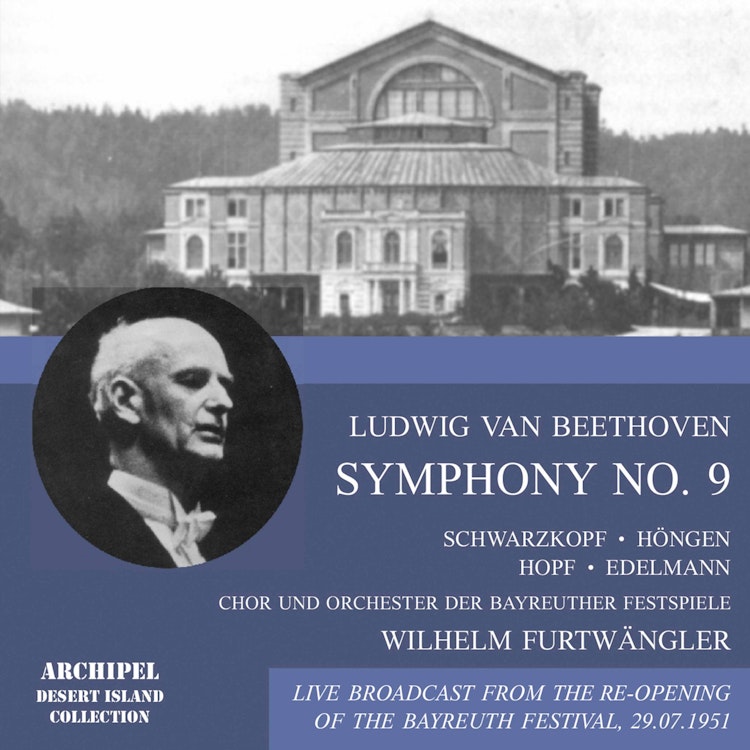
Beethoven: Symphony No. 9 in D Minor, Op. 125 "Choral" (Live)
10/2/2020, 4 Tracks, 1:14:50
Featuring
Elisabeth Schwarzkopf
Elisabeth Höngen
Hans Hopf
Otto Edelmann
Wilhelm Furtwängler
Chor der Bayreuther Festspiele
Orchester der Bayreuther Festspiele
Ludwig van Beethoven
Did you know?
1/6
Composer's Artistic Vision
Wilhelm Furtwängler, the conductor, considered Beethoven's Ninth Symphony a culminating point in Western civilization and refused to conduct it during the First World War.
Notable Performances
This 1951 performance of Beethoven's Ninth Symphony reopened the Bayreuth Festival after World War II and is considered one of the most famous recordings.
Historical Context
Richard Wagner, the composer of operas and founder of the Bayreuth Festival, conducted Beethoven's Ninth Symphony after laying the foundation stone of the Festspielhaus in 1872.
Interpretation
The 1951 Bayreuth performance of the Ninth Symphony was seen as an act of reconsecration, aiming to purge Bayreuth of its Nazi past.
Recording & Production
A recently discovered tape of this 1951 Bayreuth performance has improved the balance of the orchestra and chorus, addressing previous shortcomings in the recording.
Recording & Production
The 1951 Bayreuth recording was chosen for release by EMI after conductor Wilhelm Furtwängler's death, partly due to Elisabeth Schwarzkopf's soprano singing.
You might also enjoy...
Jokes & Jewels
Pasión
Tango Dreams
Roma - Fellini's Roma (Original Motion Picture Soundtrack)
Last Tango in Paris (Original Motion Picture Soundtrack)
Explosive (Deluxe)
La Califfa (Original Motion Picture Soundtrack)
Per un pugno di dollari (Original Motion Picture Soundtrack)