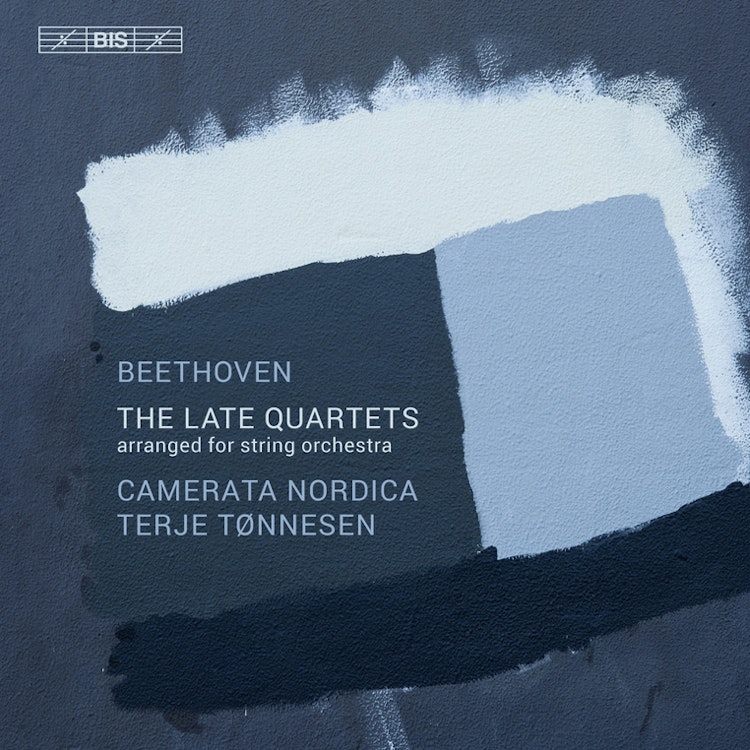
Beethoven: The Late String Quartets (Arr. T. Tønnesen for String Orchestra)
2/4/2014, 26 Tracks, 3:05:47
Featuring
Terje Tønnesen
Camerata Nordica
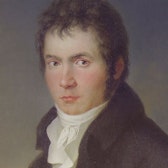
Ludwig van Beethoven
Did you know?
1/7
Interpretation
Gustav Mahler, a renowned composer and conductor, arranged Beethoven's String Quartet No. 11 for string orchestra, arguing that it provided an "ideal presentation" for larger concert halls by reinforcing the parts.
Performer Biography
Terje Tønnesen, the artistic director of Camerata Nordica, also founded the Norwegian Chamber Orchestra in 1977 and is the leader of the Oslo Philharmonic Orchestra.
Critical Reception
Beethoven's late quartets were initially considered "monstrous products of a madness" by critics, who described them as "tortuous, gloomy, overlong and indeterminate spawn of an overwrought imagination."
Composer's Artistic Vision
Theodor W. Adorno, a prominent philosopher and musicologist, viewed Beethoven's late quartets not as finished "works" but as "fragments of a single, clandestine music."
Compositional Technique
The late quartets, specifically Op. 130-133, share a common generative idea: a motif consisting of two semitone steps in different directions, a "secularized" version of the B-A-C-H motif.
Composition History
The first three of Beethoven's late quartets were commissioned by Russian Prince Nikolai Golitsïn, an amateur cellist, in November 1822.
Interpretation
Terje Tønnesen's arrangements for string orchestra aim to strengthen the contrast between powerful and intimate sections by having the latter played by soloists, similar to a concerto grosso.
You might also enjoy...
Stravinsky: Concerto in D for String Orchestra, K75: III. Rondo. Allegro
Pettersson: Concertos for String Orchestra Nos. 1-3
Presteigne Premieres: New Music for String Orchestra
The Art of Fugue
Hamerik: Symphony No. 6 / Gade: Novelettes
Hommages
Pettersson: Barefoot Songs / Concerto for Strings Nos. 1 and 2