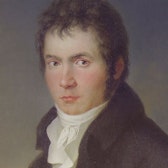
Beethoven increasingly approached his variation works from an experimental angle, deriving a whole universe from an often banal theme.
Composer Biography
Beethoven, a born improviser, initially published pieces he performed in concert without assigning them opus numbers or much importance.
Composition History
The 'Eroica' Variations are misnamed; they predate the 'Eroica' Symphony and take their theme from the finale of Beethoven's ballet 'The Creatures of Prometheus'.
Cultural Impact
The Thirty-two Variations in C minor influenced Brahms's Fourth Symphony and featured compositional principles like Klangfarbenmelodie and subtle fade-in/fade-out effects later used by Arnold Schoenberg.
Critical Reception
Beethoven himself held his Thirty-two Variations in C minor in low esteem, reportedly calling himself an 'ass' for composing them.
Composition History
The Twelve Variations in A major on a theme by Paul Wranitzky, a leader at the Vienna Court Opera, were dedicated to Countess Anna Margarete von Browne-Camus, a patron of Beethoven.
Compositional Technique
The Thirty-two Variations in C minor derive a dense harmonic framework from an eight-bar chaconne, with all variations (except the last) being eight bars long and played without interruption.
You might also enjoy...
Bach, JS : Goldberg Variations
Beethoven: Diabelli Variations
Beethoven: Piano Variations
Bach: Goldberg Variations, BWV 988
Beethoven: 8 Variations on Grétry's "Une fièvre brûlante", WoO 72
Beethoven: Piano Variations
Beethoven: Diabelli Variations
Beethoven: Diabelli Variations
Beethoven: 32 Variations in C Minor, WoO 80
Beethoven: Diabelli Variations
Beethoven: 33 Variations in C Major, Op. 120 on a Waltz by Diabelli: Var. 10. Presto