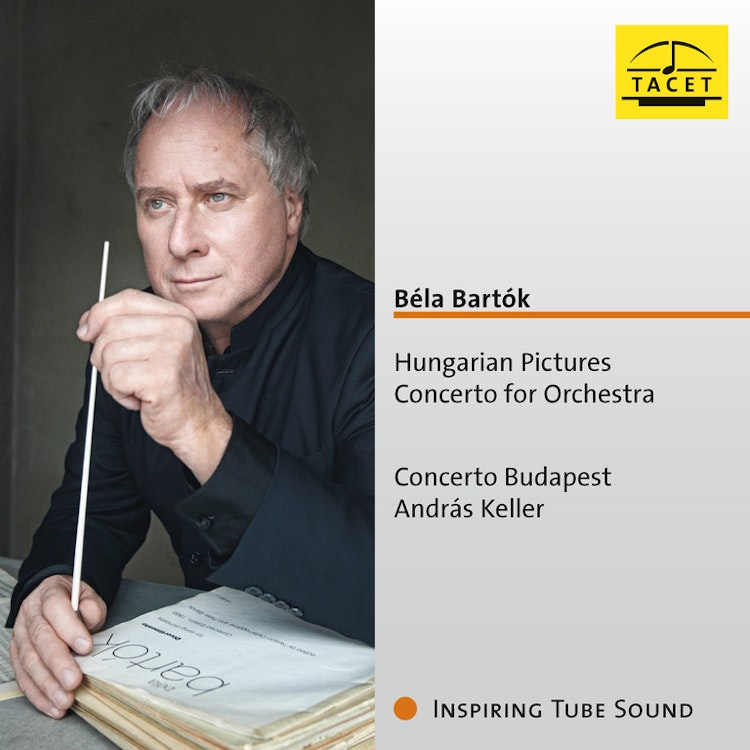
Béla Bartók: Hungarian Pictures, Concerto for Orchestra
5/4/2023, 10 Tracks, 47:37
Featuring
András Keller
Concerto Budapest Symphonic Orchestra
Béla Bartók
Did you know?
1/7
Composer's Artistic Vision
Bartók and his colleague Zoltán Kodály, a Hungarian composer and ethnomusicologist, aimed to study folk music in all its forms to foster fraternisation between peoples, and later explicitly sought a "synthesis of East and West."
Composition History
Bartók's extensive research trips from 1906 onwards, where he collected folk music, transformed him from a late Romantic composer into a music ethnologist.
Performer Biography
András Keller, the conductor of Concerto Budapest, founded the Keller String Quartet in 1987 and has since performed and given master classes worldwide.
Composer Biography
Béla Bartók, as a three-year-old, accompanied his mother playing piano on a drum, and by age 20 was performing Liszt and his own piano transcription of Richard Strauss's 'Heldenleben'.
Recording & Production
Concerto Budapest's concert film about their joint performance with Gidon Kremer and Kremerata Baltica won the Gold Medal of the Performing Arts category at the International Venice TV Award in 2020.
Compositional Technique
The Concerto for Orchestra, one of Bartók's last works, is explained by its title due to the 'concertante or solo treatment of individual instruments or groups of instruments'.
Compositional Technique
The second movement of the Concerto for Orchestra, 'Giuoco delle coppie' (Game of Pairs), features five pairs of instruments playing in specific intervals, such as two bassoons in sixths and two clarinets in sevenths.
You might also enjoy...
Bartók: Music for Strings, Percussion and Celesta, Concerto for Orchestra
Bartok: Concerto for Orchestra / Music for Strings, Percussion and Celesta
Bartók: Concerto for Orchestra; Music for String Instruments Percussion and Celesta
Bartók: Orchestral Works
Bliss: Morning Heroes & Hymn to Apollo
Bartók: Concerto for Orchestra/Music for Strings, Percussion & Celesta
Bartók: Orchestral Works
Bartók: Music for Strings, Percussion & Celesta, Sz. 106 and Concerto for Orchestra, Sz. 116