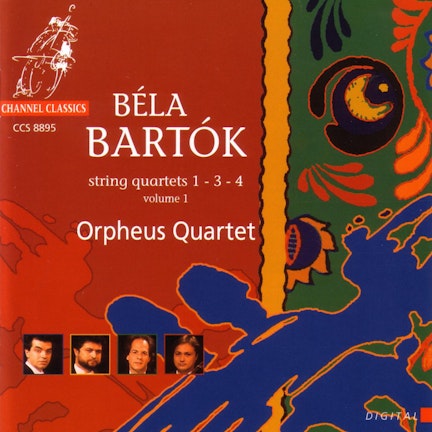
Béla Bartók used his string quartets to crystallize musical innovations he first explored in shorter piano pieces, allowing him to present his ideas on a larger scale and in their purest form.
Composer's Artistic Vision
Bartók's early discoveries of Debussy's music and authentic Hungarian folklore helped him break free from the influence of Wagner, Liszt, and Richard Strauss, allowing him to find his own musical path.
Compositional Technique
Bartók's Third Quartet, composed in 1927, is innovative in its string playing, introducing various glissandos and vibratos, specifying bow lengths, and combining pizzicatos, harmonics, and other techniques for unprecedented sonorities.
Composition History
Bartók's First Quartet was a farewell to violinist Stefi Geyer, for whom he had an unrequited passion, and the score contains secret references to her.
Compositional Technique
Bartók's Fifth Quartet, like his Fourth, employs a palindromic structure, with a central scherzo forming the axis of symmetry.
Compositional Technique
The sorrowful opening of Bartók's First Quartet reuses a theme from his First Violin Concerto, which was a gift of love to Stefi Geyer, but here it is distorted to become his 'funeral dirge'.
Composer's Artistic Vision
The Fifth Quartet marks the beginning of Bartók's 'classicism' period, where he achieved a synthesis of linguistic mastery and expressive hedonism, as seen in works like 'Music for strings, percussion and celesta'.