Webern's Langsamer Satz, the earliest work on this album, was written in 1905 while he was a composition student of Arnold Schoenberg and finishing his doctoral dissertation.
Compositional Technique
Arnold Schoenberg's String Quartet No. 2, Op. 10, marks a major turning point, audibly demonstrating the transition from late Romanticism to free atonal 'expressionist' language.
Composer's Artistic Vision
Arnold Schoenberg praised Berg's String Quartet, Op. 3, for its 'fulness and unconstraint of its musical language' and 'significant originality', noting Berg's desire to move beyond classical forms.
Historical Context
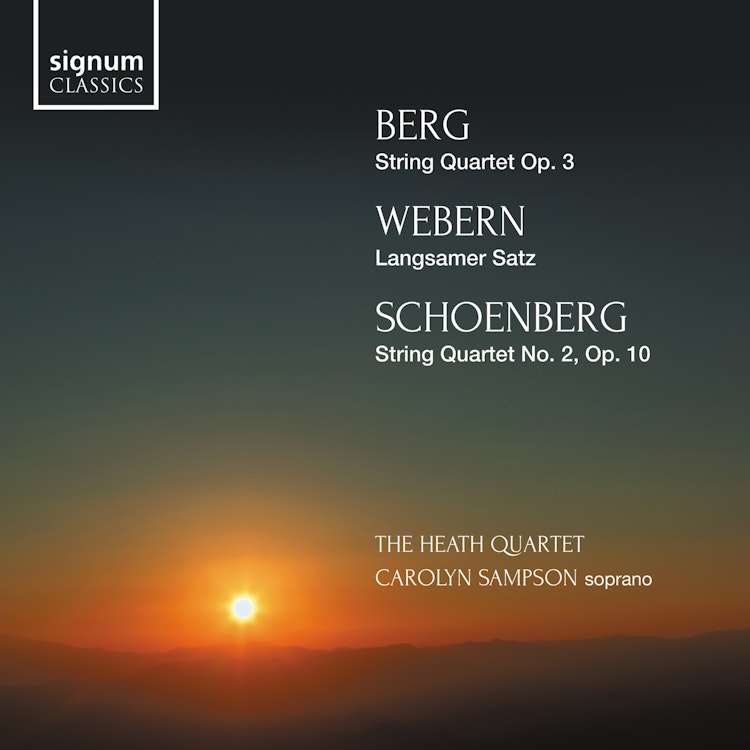
This album features works by Schoenberg, Berg, and Webern, showcasing the musical language developments of Schoenberg and his two main pupils over five years in the early 20th century.
Composition History
Berg's String Quartet, Op. 3, was the last of his 'graduation' pieces completed under the tutelage of Arnold Schoenberg, a renowned composer and teacher.
Compositional Technique
Berg's String Quartet, Op. 3, employs Schoenberg's concept of 'developing variation,' where musical ideas are constantly modified and varied to create new motives.
Composer Biography
Webern's Langsamer Satz is a love song to his cousin Wilhelmine, with whom he fell in love while hiking in Lower Austria, and whom he later married.
You might also enjoy...
Shostakovich: Last Three String Quartets; 50th Anniversary Recording