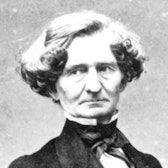
Berlioz's overtures often follow a standard outline: a contrast between 'dreams of love' and 'honour and arms', inspired by a quotation from Walter Scott's novel, Waverley.
Composition History
Berlioz composed the overture Le Roi Lear in Nice in 1831 while recovering from an emotional crisis, after reading Shakespeare's play in Florence.
Compositional Technique
Le Carnaval romain, an overture extracted from Berlioz's opera Benvenuto Cellini, is noted for best revealing his brilliant and breathtaking orchestral gifts.
Compositional Technique
The timpani figure at the end of the introduction to Le Roi Lear represents the king's entry into his council chamber, based on a drumbeat that accompanied King Charles X of France.
Composition History
Berlioz considered the Overture to 'Les Francs-juges', composed in 1826, to be his first substantial instrumental composition.
Critical Reception
Berlioz's second opera, Benvenuto Cellini, was received with hostility at its 1838 Paris premiere and quickly withdrawn, partly due to its unflinching rhythmic energy.
Performer Biography
The Bergen Philharmonic Orchestra, one of the world's oldest orchestras, dates back to 1765 and will celebrate its 250th anniversary in 2015.
You might also enjoy...
Berlioz: Overtures
Janáček: Jealousy
Berlioz Overtures
Berlioz Overtures
Suppé: The Famous Overtures
Berlioz Overtures
Moniuszko: Verbum nobile: Overture
Offenbach Ouvertures
NIELSEN: Helios Overture
Offenbach: Overtures
Berlioz: Overtures
Schubert: Overture from Der vierjährige Posten, D. 190
Adam: Overture from Si j'étais roi (If I Were King) (Digitally Remastered)