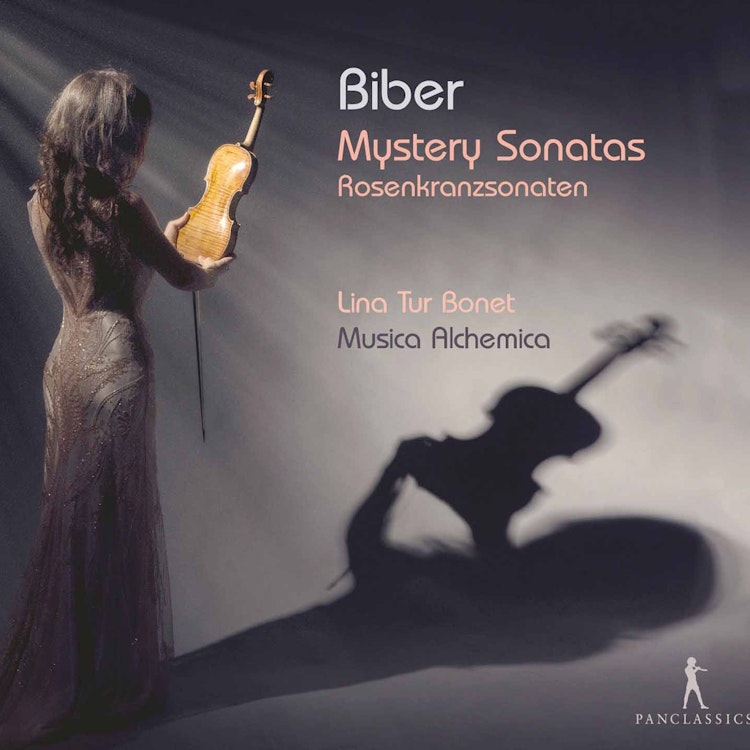
Each sonata in the Biber Mystery Sonatas manuscript is preceded by a small engraving relating to one of the 15 Mysteries of the Rosary.
Interpretation
The choice of continuo instruments for this recording is based on personal and coloristic symbolism, with each instrument representing specific characters or emotions.
Compositional Technique
The Biber Mystery Sonatas are notable for their use of 15 different scordaturas, or violin tunings, a technique used in 17th-century Germany but never to such an extreme.
Composer's Artistic Vision
Biber dedicated this unique manuscript to his employer, Prince-Archbishop Maximilian Gandolph, who supported a Confraternity in Salzburg dedicated to praying the Rosary.
Compositional Technique
The violin part in Biber's Mystery Sonatas is notated as if the instrument were tuned normally, but the scordaturas cause the actual pitches to differ from what is written.
Composer Biography
Biber's possible Jesuit education suggests the purpose of the composition, as St Ignatius Loyola advised a sensorial experience in spiritual exercises.
Composer's Artistic Vision
Biber depicted himself as an 'Orphic poet' with his 'lyre of four strings re-tuned in 15 different manners,' drawing an analogy between Jesus Christ and Orpheus.
You might also enjoy...
Wail - Strech (Midnight Recordings)
Pietro Vinci: Ricercari a tre voci
Compositrices (Bon, von Bayreuth, Jacquet de la Guerre)
Mimesis - Transcriptions of Bach works
Do Not Lament
Marin Marais: Pièces de viole des Cinq Livres
Rodio, Mayone, De Macque: Di voci affettuose, Ricercari napoletani
J.S. Bach: Harpsichord Partitas, BWV 825-830
Il cembalo intorno a Gesualdo: Paola Erdas
Carolo: Trio Sonatas Nos. 1-10
All I Hear Is Birds
lumina
Anonymous: Sonata in F for Recorder and Basso Continuo
Benedetto Marcello: Sonata in F Major for Recorder and Basso Continuo, Op. 12 No. 2