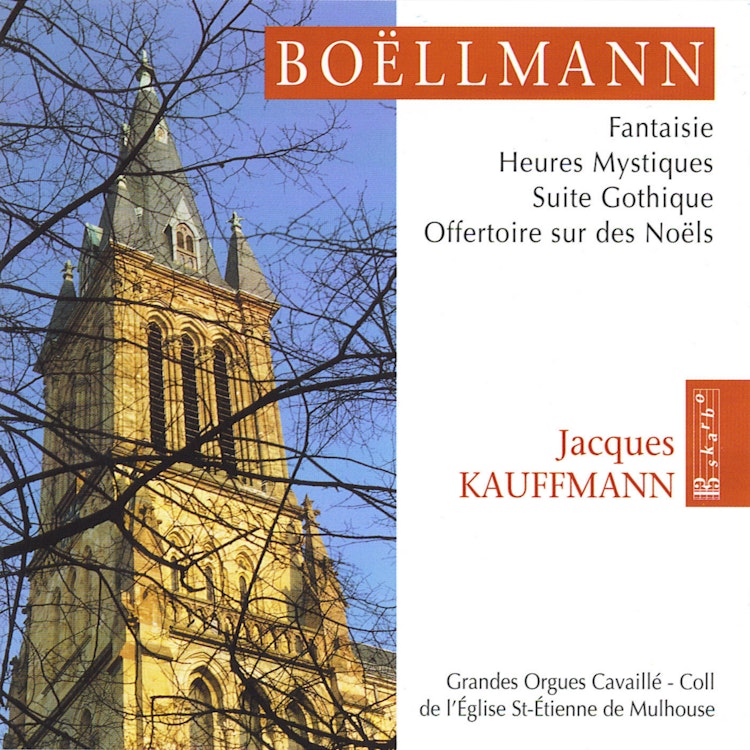
Boëllmann: Fantaisie - Heures Mystiques - Suite Gothique & Offertoire sur des Noëls
8/1/2013, 18 Tracks, 1:11:57
Featuring
Jacques Kauffmann
Léon Boëllmann
Did you know?
1/7
Composer's Artistic Vision
Despite being influenced by his teachers like Saint-Saëns, Franck, Fauré, and Gigout, Boëllmann developed a personal musical style characterized by simplicity, elegance, and skillful counterpoint.
Historical Context
The 'Gothic' title of Boëllmann's suite was likely influenced by Widor's 'Gothic Symphony' and Benjamin Godard's earlier 'Gothic Symphony', reflecting a trend of using architectural terms in music.
Compositional Technique
The 'Heures Mystiques' collection consists of 100 pieces, designed to be adaptable for both organ and harmonium, and suitable for various liturgical moments in all tonalities.
Composer Biography
Boëllmann's musical education was at the Music School founded by Louis de Niedermeyer, which aimed to train organists and choirmasters.
Composition History
Boëllmann's 'Heures Mystiques' (Mystic Hours) was likely commissioned by publisher Wilhelm Enoch, similar to Franck's 'L'Organiste'.
Composition History
The 'Suite Gothique' was composed for the inauguration of a new organ in Notre Dame de Dijon on May 27, 1895.
Composer Biography
Léon Boëllmann, the composer, was orphaned at a young age and raised by his uncle by marriage, Eugène Gigout, who was also an organist.
You might also enjoy...
Zungen aus Feuer
The Organ of Coventry Cathedral
Retrospektiven
Petrali: Organ Music
Christmas Organ Music from St. Paul's Cathedral
The Great Organ of the Licheń Basilica
Muzyka organowa w parafii św. Barbary w Warszawie
Otto Olsson: Organ Works
Toccatas & Meditations
Nowowiejski: Warmia Ermland
Organ Recital: Higgs, David - Bach, J.S. / Franck, C. / Schumann, R. / Mozart, W.A. / Conte, D. / Liszt, F. / Daquin, L. (Inaugural Recital)
Reger: Organ Works, Vol. 6
Priory LP Archive Series, Vol. 5: Music on the Organ of Truro Cathedral