The Hungarian Dances, originally composed for piano duet, were among the most popular works Brahms wrote in Hungarian style, with the first two sets issued in 1869 and the second pair in 1880.
Compositional Technique
While the Hungarian Dances make use of some gypsy melodies, three of them (Nos. 11, 14, and 16) are original compositions by Brahms.
Cultural Impact
The Hungarian Dances were immediately popular, partly because piano duets were a common form for domestic entertainment and for performing transcribed orchestral works.
Composition History
Brahms's interest in Hungarian music began in 1850 after meeting Hungarian violinist Reményi, who introduced him to Hungarian gypsy music.
Composition History
Brahms himself orchestrated the first, third, and tenth Hungarian Dances in 1885, while Czech composer Antonín Dvořák orchestrated the last five.
Composer Biography
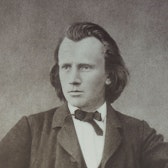
Johannes Brahms, born in Hamburg, Germany, initially wished to return to his native city for a substantial musical position but eventually settled in Vienna.
You might also enjoy...
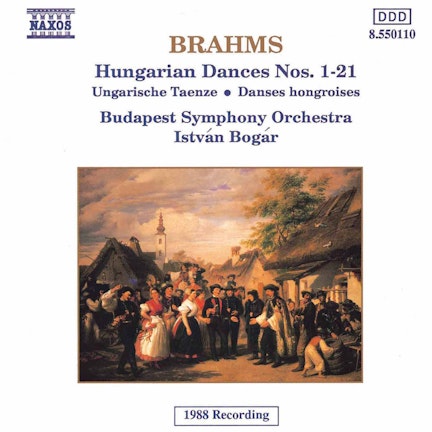
Brahms: Hungarian Dances Nos. 1-21
Hungarian Dances
Lumbye, H.C.: Orchestral Music
Lumbye: Orchestral Works, Vol. 9
Lumbye: Orchestral Works, Vol. 9
Vienna Ball: Strauss Family Waltzes, Polkas & Marches