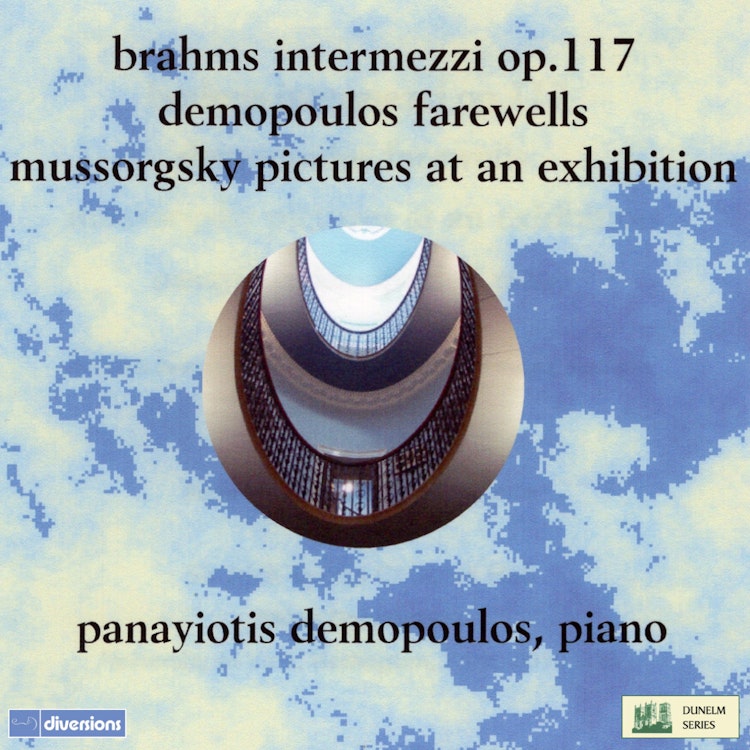
Brahms: 3 Intermezzi, Op. 117 - Demopoulos: Farewells - Mussorgsky: Pictures at an Exhibition
1/19/2018, 23 Tracks, 53:05
Featuring
Panayiotis Demopoulos
Johannes Brahms
Modest Mussorgsky
Did you know?
1/7
Composer Biography
The personal character of Brahms's Three Intermezzi, Op. 117, may reflect the recent deaths of many close friends, including his younger sister Elise Grund, who succumbed to illness earlier that year.
Composer's Artistic Vision
Brahms himself referred to the third intermezzo of Op. 117 as "a cradle song for all his grief," possibly an indirect reference to Clara Schumann through a Robert Schumann lied.
Composition History
Johannes Brahms composed his Three Intermezzi, Op. 117, during a summer holiday in Ischl in 1892, as part of a series of short pieces.
Compositional Technique
In the third farewell (winter) of Panayiotis Demopoulos's work, 87 of the 88 piano strings are activated once each, exploring a series of tones and durations.
Compositional Technique
The first intermezzo in Brahms's Op. 117 is prefaced with a short excerpt from a Scottish lullaby, which fits its slow harmonic pace and simple rhythmic invention.
Composition History
Modest Mussorgsky's Pictures at an Exhibition was created after the premature death of his close friend, the architect and painter Victor Hartmann, and an exhibition held in his honor.
Composition History
Panayiotis Demopoulos's Four Farewells for piano were each written in a different season and are dedicated to his piano teachers, Margaret Murray-McLeod and Murray McLachlan.
You might also enjoy...
Goldberg Var.
Wellesz, E.: Piano Music (Complete)
Key Words - Piano Parlando 1
Bartók, Janáček & Kurtág: Piano Works (A Concert in Paris)