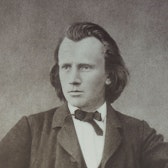
Antonín Dvořák's Rondo and Waldesruhe were written for a farewell tour before his long stay in America, and Brahms kindly corrected the proofs for the Rondo to avoid publication delays.
Composer's Artistic Vision
Brahms expressed regret at not composing a cello concerto after hearing Antonín Dvořák's masterpiece, saying he would have tried if he had known such a work was possible.
Compositional Technique
Brahms's Cello Sonata No. 1 in E minor, Op. 38, is an "historical sonata" that quotes Bach's Art of Fugue and resembles Beethoven's Cello Sonata in A major.
Composition History
Brahms's Cello Sonata No. 1 in E minor, Op. 38, started in 1862 when he was under thirty, was his first surviving duo-sonata and marked a turning point in his style.
Performer Biography
Steven Isserlis, the cellist on this recording, was awarded a CBE in 1998 for his services to music and received the Schumann Prize of the City of Zwickau in 2000.
Composer Biography
Johannes Brahms seriously studied the cello in his youth, reaching a level where he could play difficult concertos, but his teacher vanished with his instrument.
Critical Reception
The premiere of Brahms's Cello Sonata No. 2 in F major, Op. 99, in 1886 was met with harsh criticism, with Hugo Wolf calling it "total chaos" and Brahms "the greatest charlatan."
You might also enjoy...
Haydn - Schubert - Brahms
Hummel, Moscheles, Ries: Cello Sonatas
Dobrzyński: Chamber Works
Kodály: Sonatas for Cello and Piano
KODALY: Three Chorale Preludes / Cello Sonatas Opp. 8 and 4
Barber: Cello Sonata in C Minor - Grieg: Cello Sonata in A Minor - Martinů: Variations on a Slovak Folksong