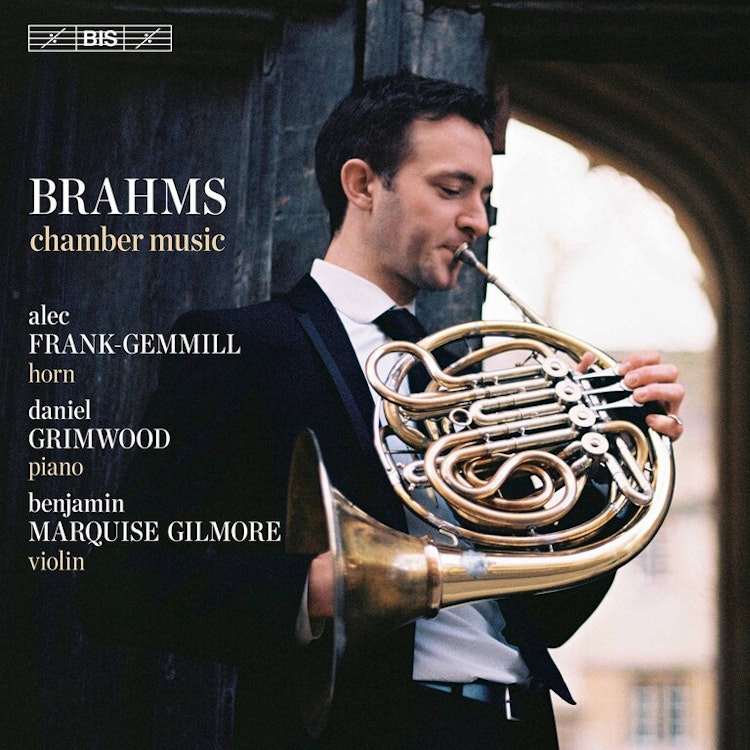
The horn used for the Trio on this album is a Raoux-Labbaye natural horn from Paris, circa 1871-76, with a piston-valve section by William Brown, and was previously owned by the Brain family.
Composition History
Brahms's Scherzo in C minor was part of a collaborative 'FAE Sonata' for violinist Joseph Joachim's birthday, also featuring movements by Robert Schumann and Albert Dietrich.
Composition History
Brahms's Horn Trio, Op. 40, was written shortly after his mother passed away, a link almost explicitly made by the title of the third movement, Adagio mesto ('sad' or 'pensive').
Interpretation
The performers chose a French natural horn for this recording, similar to the one used in Aubrey Brain's seminal 1933 recording, to evoke a 'romantic sonority' and nostalgia.
Composer's Artistic Vision
Brahms preferred the Waldhorn (natural horn) over the valve horn for his Trio, believing that valve horns made players too loud and caused 'all poetry' to be lost.
Historical Context
The Waldhorn (natural horn) was a crucial marker for the romantic spirit of the 19th century, with its sound evoking 'woodland lyricism' for poets like Eichendorff and Lenau.
Compositional Technique
Brahms's Cello Sonata No. 1, Op. 38, features a fugal finale whose first theme is often compared to the 13th Contrapunctus from J. S. Bach's Art of the Fugue.
You might also enjoy...
Burgmuller: Complete Piano Music - Mendelssohn: Trauermarsch, Op. 103 - Burgmuller: Valse Brillante - 25 Etudes
Goldstone, A.: Tzigane (A Treasury of Gypsy Inspired Music)
Sounds of North
Piano Music - Weber, C.M. Von / Liszt, F. / Mozart, W.A. / Chopin, F. (Welte-Mignon Piano at Hotel Waldhaus Sils Maria, Vol. 1)