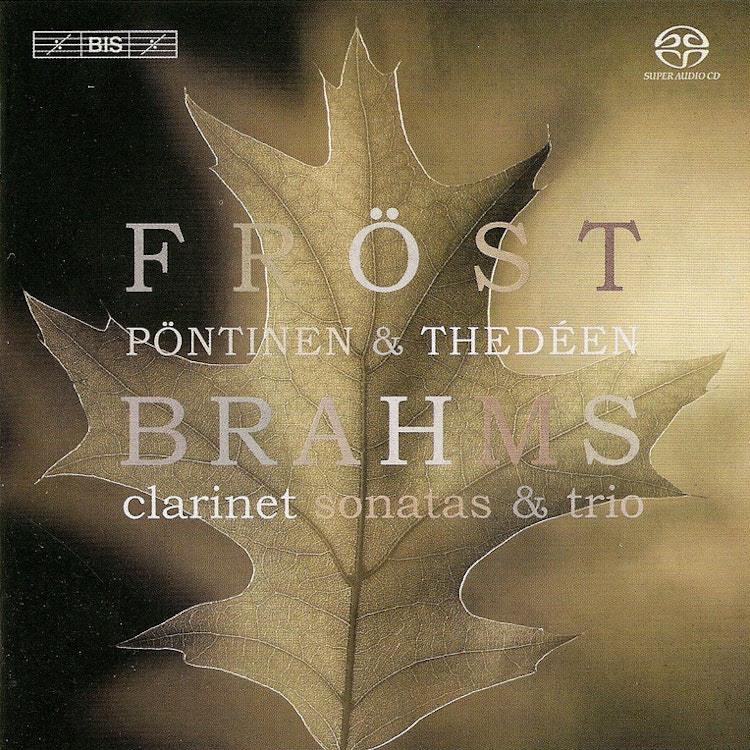
Brahms: Clarinet Sonatas Nos. 1 and 2 / Clarinet Trio
7/1/2000, 12 Tracks, 1:07:14
Featuring
Martin Fröst
Roland Pöntinen
Torleif Thedéen
Johannes Brahms
Did you know?
1/7
Recording & Production
This Hybrid SACD recording aims to reproduce the natural sound of a concert venue as faithfully as possible, using a 5.0 surround sound configuration with all five channels recorded using the full frequency range.
Composer's Artistic Vision
The works on this album belong to Brahms's 'autumnal period' after 1890, characterized by a focus on emotion, inwardness, and intimacy, avoiding hollow virtuosity.
Composition History
Johannes Brahms composed his clarinet works for a specific interpreter, Richard Mühlfeld, a clarinettist who inspired him to write four pieces between 1891 and 1894.
Compositional Technique
Brahms's Trio for Clarinet, Cello and Piano, Op. 114, uses the clarinet in A, which produces a more sombre tone than the B flat clarinet, and explores the instrument's full range, including its low 'chalumeau' register.
Composer Biography
Brahms nicknamed Richard Mühlfeld, the clarinettist who inspired his late works, 'Miss Clarinet' due to the delicacy of his tone.
Composer Biography
Before meeting Richard Mühlfeld, Brahms believed himself to be 'empty' of inspiration after composing his String Quintet No.2, Op.111, and had destroyed sketches and incomplete manuscripts.
Critical Reception
Brahms, in his usual self-deprecating way, described his Clarinet Trio, Op. 114, as 'the twin of an even greater stupidity' (referring to the Clarinet Quintet), which may have contributed to its relative obscurity compared to the quintet.
You might also enjoy...
Brahms: Sonaten, Op. 120 & Trio, Op. 114
Brahms: Sonatas & Trios
Brahms: Sonaten Op. 120 & Trio Op. 114
Brahms: Clarinet Sonatas & Clarinet Trio
Brahms: Two Sonatas for Clarinet and Piano, Op. 120 and Trio for Clarinet, Cello, and Piano, Op. 114