Brahms requested his publisher to display a picture of a head with a pistol pointing at it on the title page of Op. 60, humorously suggesting it would give an idea of the music.
Cultural Impact
Brahms's Piano Quartet No. 3, Op. 60, is often referred to as the Werther Quartet, referencing J.W. Goethe's novel The Sorrows of Young Werther and its protagonist's suicide due to unrequited love.
Recording & Production
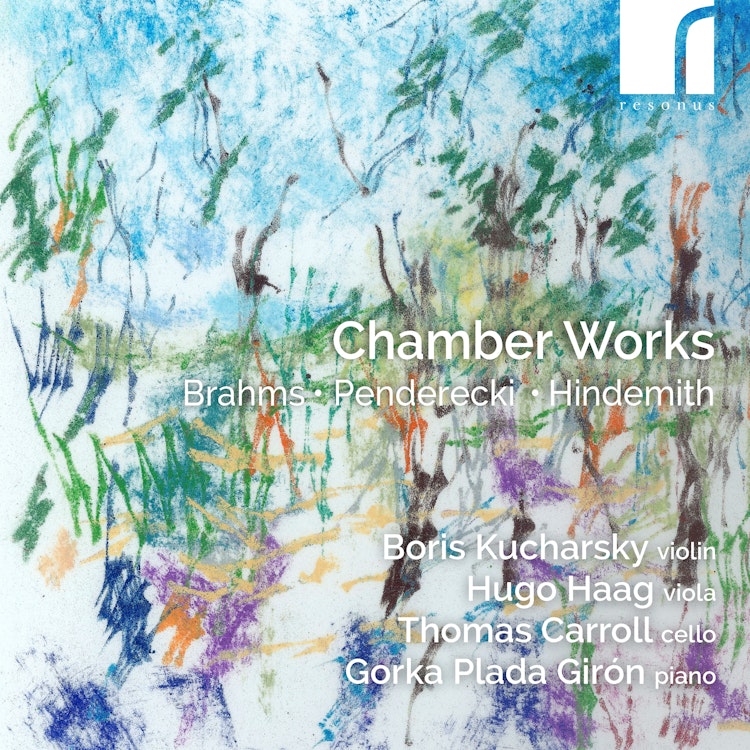
This album was recorded in two locations: Potton Hall, Suffolk, for the Brahms and Hindemith pieces, and Ayriel Studios, North Yorkshire, for the Penderecki piece.
Composition History
Brahms's Piano Quartet No. 3, Op. 60, was originally conceived around 1855 during a turbulent period for Robert and Clara Schumann, with whom Brahms was obsessively preoccupied.
Composer Biography
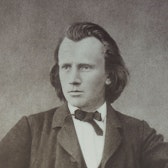
Brahms expressed deep feelings for Clara Schumann, writing in a letter that he believed he admired, honored, loved, and was in love with her.
Performer Biography
Boris Kucharsky, the violinist on this album, is a protégé of the legendary Yehudi Menuhin and plays the 'Baron Knoop' violin by Carlo Bergonzi, made in Cremona in 1735.
Compositional Technique
The first movement of Brahms's Piano Quartet No. 3 contains Robert Schumann's 'Clara theme' (C-B-A-G-sharp-A), transposed in the violin to E♭-D-C-B-C.
You might also enjoy...
Saint-Saëns: Piano Quartet, Barcarolle & Piano Quintet
Eisler, Ravel & Jörg Widmann: Duos
Hindemith: Werke für Viola
Weir: Piano Concerto, Distance and Enchantment & Other Works
Martinů & Suk: Piano Quartets - Dvořák: Bagatelles, Op. 47