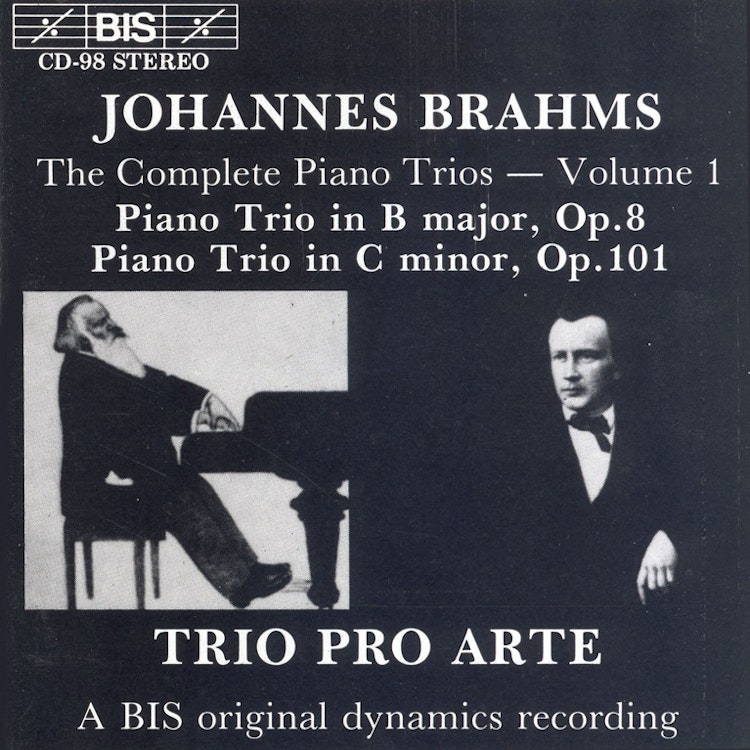
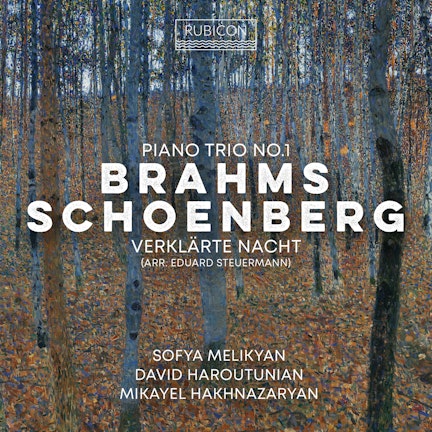
Brahms was exceptionally skilled at extracting a rich sound from the piano trio combination, not only through his substantial piano parts but also his understanding of the violin and cello's most resonant registers.
Instruments
The violin used in this recording is a Josef Gagliano from Naples, 1770, and the cello is a Gaspar Bertoletti ("da Salo") from 1609.
Performer Biography
Elisabeth Westenholz, the pianist of Trio Pro Arte, achieved the best final examination result in the history of the Copenhagen Academy of Music.
Compositional Technique
In his Trio No. 3 in C minor, Brahms experimented boldly with rhythm, including seven-bar phrases constructed from varying time signatures like 3/4 and 2/4, and also incorporating 5/4 time.
Composer's Artistic Vision
Brahms's chamber music, though often overshadowed by his symphonies, exhibits the same stylistic features and often possesses a symphonic scale.
Composition History
Brahms's Trio No. 1 in B major exists in two versions: an original from his youth at 21, and a revised version he made 37 years later with more elaborate secondary themes.
Composition History
The authenticity of Brahms's A major Trio was long disputed due to a missing title page on its manuscript, but stylistic analysis has largely attributed it to him.
You might also enjoy...
Patrick Zimmerli - Piano Trios
Sinding: Piano Trios Nos. 2 and 3
Sinding: Piano Trios Nos. 2 and 3
Arensky: Trio, Op. 32 - Smetana: Trio, Op. 15
Dvořák: Piano Trios Nos. 3 & 4, "Dumky", Vol. 1
Brahms: Piano Trio No. 1 - Schoenberg: Verklärte Nacht
Dvořák: Piano Trios Nos. 3 & 4
The Piano Trio Collection - Dvorák: Trio No. 3 in F Minor, Op. 65 & Trio No. 4 in E Minor, Op. 90 "Dumky" - Heifetz Remastered
Tchaikovsky, Rachmaninoff: Piano Trio in A Minor, Trio Élégiaque
Arensky: Piano Trio No. 1 - Glinka: Trio Pathétique